Car seat laws in California
What California law requires at each stage, from rear-facing to the front seat, next to what NHTSA and the AAP recommend. Plus the fine and where to get a free car seat check.
Checked October 2026 · 10 sources · Not legal advice
Short answer
Sources: California Legislative Information; California Highway Patrol. Data as of October 2026.
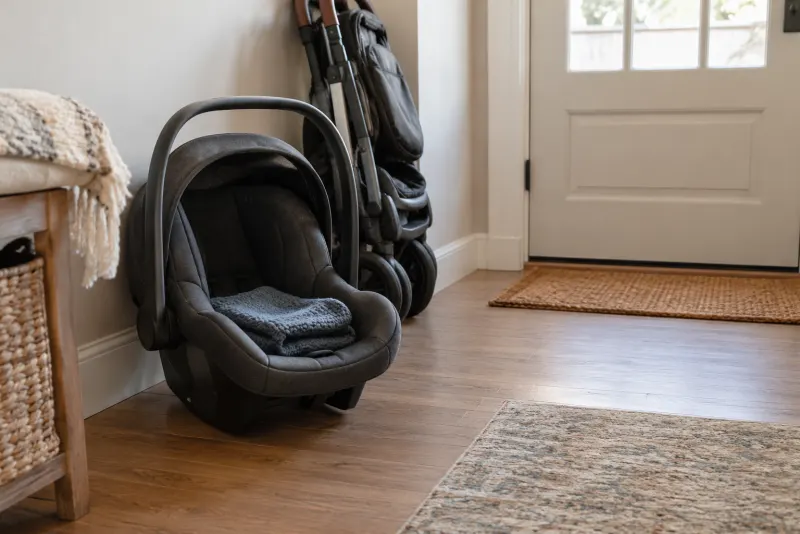
What does California car seat law require at each age?
The law sets the minimum. NHTSA and the AAP recommend keeping each stage until your child outgrows the seat, which usually means longer.
| Stage | What California law requires | NHTSA and AAP guidance |
|---|---|---|
Rear-facing car seatBest practice goes further | A child under two must ride in a rear-facing child passenger restraint system unless the child weighs 40 or more pounds or is 40 or more inches tall, secured within the seat maker's height and weight limits. | NHTSA and the AAP recommend keeping your child rear-facing as long as possible, until they reach the top height or weight limit allowed by the car seat's manufacturer. A child under age 1 should always ride rear-facing, and most convertible seats allow rear-facing for 2 years or more. |
Forward-facing seat with a harnessNo state rule | California law doesn't set an age for moving from a five-point harness to a booster (the CHP says the law does not address it). | NHTSA and the AAP recommend using a forward-facing car seat with a harness and tether once your child outgrows the rear-facing limits, for as long as possible, up to the highest weight or height the seat's manufacturer allows. |
Booster seatBest practice goes further | A child under eight must be properly secured in a rear seat in an appropriate child passenger restraint system. A child under eight who is 4'9" or taller may use a safety belt instead. | NHTSA and the AAP recommend using a belt-positioning booster seat after your child outgrows the harnessed seat, until the vehicle seat belt fits properly, typically when they reach about 4 feet 9 inches tall and are 8 to 12 years old. |
Seat belt | Children 8 through 15 must be secured in an appropriate child passenger restraint system or a safety belt. A child over 40 pounds may wear only a lap belt in the back seat if it has no lap-and-shoulder belt. | NHTSA and the AAP recommend moving to the seat belt alone only when it fits: the lap belt lies snugly across the upper thighs, not the stomach, and the shoulder belt crosses the middle of the chest and shoulder, not the neck or face. Children big enough for the belt alone should always use a lap and shoulder belt. |
Back seatBest practice goes further | Children under 8 must ride in the rear seat. Exceptions: no rear seat, side-facing jump seats, rear-facing rear seats, the restraint can't be installed properly in back, all rear seats are taken by children 7 or under, or a medical reason. A rear-facing seat may never go in front of an active frontal passenger airbag. | NHTSA and the AAP recommend keeping all children younger than 13 in the back seat. |
The law: Cal. Veh. Code §§ 27360, 27360.5, 27360.6, 27363, in effect since January 1, 2017.
Sources: California Legislative Information; California Highway Patrol; Insurance Institute for Highway Safety; Governors Highway Safety Association. Data as of October 2026.
What are the fines and exemptions in California?
First offense
$100
$100 for a first offense and $250 for a second or later one (before court penalty assessments). The court may reduce or waive the fine for an economically disadvantaged defendant who completes a community child passenger safety education program.
Exemptions
The court may exempt a child whose physical unfitness, medical condition or size makes a restraint impractical. Life-threatening emergencies and authorized emergency vehicles are exempt when no restraint is available (the child must use a seat belt). The section doesn't apply to a driver when the child's parent or legal guardian is a passenger.
Driver's-license points are not confirmed (IIHS reports California assesses points). Neither IIHS nor GHSA mentions the AB 435 change for 2027, and GHSA's California entry is garbled ('Children under 8 years old or have reached 4'9" ... may be secured by a booster seat').
Where can you get your car seat checked for free?
Certified child passenger safety technicians check car seats at inspection stations nationwide. NHTSA says they inspect seats free of charge in most cases and show you how to install and use the seat correctly, and some locations offer virtual inspections. Search NHTSA's locator by ZIP code or city (it can filter for Spanish-speaking technicians), or find a technician through Safe Kids Worldwide. California lists its own fitting stations.
Sources: National Highway Traffic Safety Administration; American Academy of Pediatrics (HealthyChildren.org)
Where are the car seat inspection stations in California?
NHTSA's locator lists 205 car seat inspection stations in California, in 135 cities and towns. Los Angeles has the most (18), then Pasadena and Sacramento (5 each). NHTSA flags 21 of them as Spanish-speaking.
205
inspection stations in NHTSA's locator
NHTSA, October 2026
135
cities and towns with a station
NHTSA, October 2026
21
flagged as Spanish-speaking
NHTSA, October 2026
18
of 205 records updated since 2023
Newest: January 18, 2024
Cities with the most stations
- Los Angeles18 stations
- Pasadena5 stations
- Sacramento5 stations
- Bakersfield4 stations
- Santa Monica4 stations
- Fresno3 stations
- Glendale3 stations
- Madera3 stations
Plus 127 more cities and towns. Search NHTSA's locator by ZIP code for the ones near you.
Spanish-speaking stations are listed in Arbuckle, Carmichael, Colusa, Dublin, Fairfield, Hanford, Lincoln and Los Banos, and 10 more places. Use the locator's Spanish-speaking filter to see them.
15 are mobile stations that travel to checkup events, so call for the next date and place.
Source: National Highway Traffic Safety Administration. Data as of October 2026.
Choosing and getting a car seat
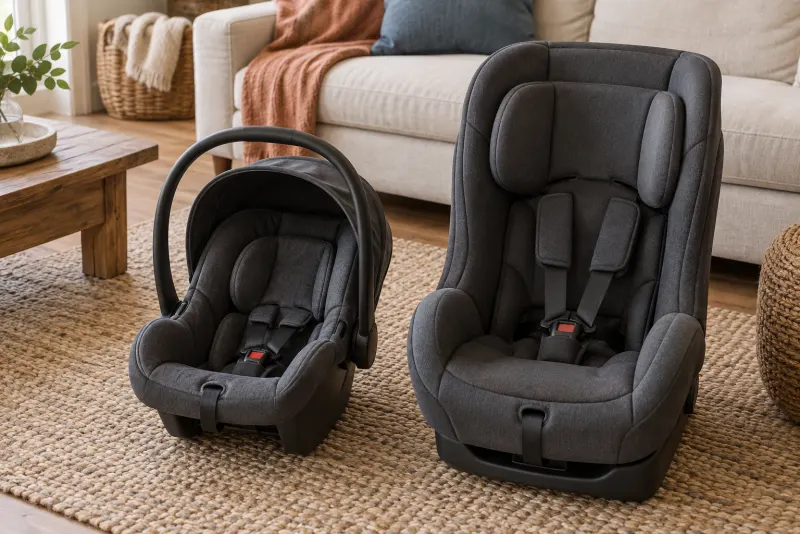 Infant vs convertible car seat: which to buy firstInfant vs convertible car seat, compared with AAP and NHTSA guidance: rear-facing limits, portability, when to switch, installation and free seat checks.
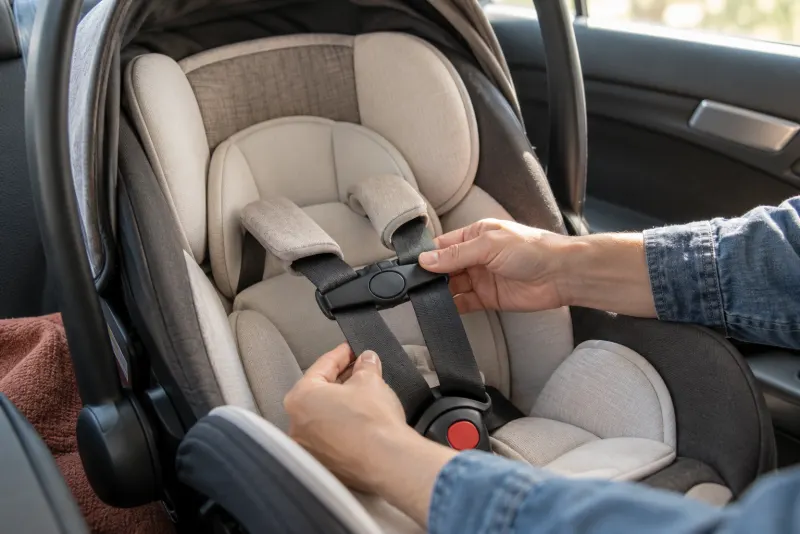 How to get a free car seatWhere to get a free infant car seat in 2026: Medicaid plan extras, Safe Kids coalitions and 211, plus free installation checks and when a used seat isn't safe.
Questions about car seat laws in California
When can a child face forward in a car seat in California?
A child under two must ride in a rear-facing child passenger restraint system unless the child weighs 40 or more pounds or is 40 or more inches tall, secured within the seat maker's height and weight limits. NHTSA and the AAP recommend going further: keeping your child rear-facing as long as possible, until they reach the top height or weight limit allowed by the car seat's manufacturer. A child under age 1 should always ride rear-facing, and most convertible seats allow rear-facing for 2 years or more.
When can a child stop using a booster seat in California?
A child under eight must be properly secured in a rear seat in an appropriate child passenger restraint system. A child under eight who is 4'9" or taller may use a safety belt instead. NHTSA and the AAP recommend going further: using a belt-positioning booster seat after your child outgrows the harnessed seat, until the vehicle seat belt fits properly, typically when they reach about 4 feet 9 inches tall and are 8 to 12 years old. The AAP says an adult seat belt fits when: the shoulder belt lies across the middle of the chest and shoulder, not the neck or throat; the lap belt is low and snug across the upper thighs, not the belly; and the child is tall enough to sit against the vehicle seat back with knees bent over the edge of the seat without slouching, and can stay that way for the whole trip. NHTSA uses the same lap-belt and shoulder-belt checks. The 5-step test, which California writes into law from January 1, 2027, asks: 1) Does the child sit all the way back against the seat? 2) Do the knees bend over the edge of the seat? 3) Does the shoulder belt snugly cross the center of the chest and shoulder, not the neck? 4) Is the lap belt as low as possible, touching the thighs? 5) Can the child stay seated like this for the whole trip?
How old does a child have to be to sit in the front seat in California?
Children under 8 must ride in the rear seat. Exceptions: no rear seat, side-facing jump seats, rear-facing rear seats, the restraint can't be installed properly in back, all rear seats are taken by children 7 or under, or a medical reason. A rear-facing seat may never go in front of an active frontal passenger airbag. NHTSA and the AAP recommend going further: keeping all children younger than 13 in the back seat.
What is the fine for a car seat violation in California?
$100 for a first offense and $250 for a second or later one (before court penalty assessments). The court may reduce or waive the fine for an economically disadvantaged defendant who completes a community child passenger safety education program.
Is the California car seat law changing?
Yes, from January 1, 2027. AB 435 (Stats. 2025, Ch. 434) takes effect January 1, 2027. A child 8 to 15, or a child under 8 who is 4'9" or taller, will count as 'properly restrained by a safety belt' only if they pass all five steps of the 5-step test: sitting all the way back against the seat, knees bending over the seat edge, shoulder belt snug across the center of the chest and shoulder and not the neck, lap belt as low as possible and touching the thighs, and able to stay seated like this for the whole trip. Otherwise they must stay in a child passenger restraint system such as a booster.
Where can I get a car seat inspection in California?
NHTSA's locator lists 205 car seat inspection stations in California, in 135 cities and towns. Los Angeles has the most (18), then Pasadena and Sacramento (5 each). NHTSA flags 21 of them as Spanish-speaking. Certified technicians check seats for free in most cases. Search NHTSA's locator by ZIP code and call the station before you go.
More for parents in California
Sources
- 1.California Vehicle Code § 27360 California Legislative Information. Accessed October 14, 2026.
- 2.California Vehicle Code § 27360.5 (current version and version operative January 1, 2027, AB 435, Stats. 2025, Ch. 434) California Legislative Information. Accessed October 14, 2026.
- 3.California Vehicle Code § 27360.6 (penalties) California Legislative Information. Accessed October 14, 2026.
- 4.Child Safety Seats California Highway Patrol. Accessed October 14, 2026.
- 5.Seat belt and child seat laws (table dated October 2026) Insurance Institute for Highway Safety. Accessed October 14, 2026.
- 6.Child Passenger Safety state laws (last updated October 2025) Governors Highway Safety Association. Accessed October 14, 2026.
- 7.Car Seats and Booster Seats National Highway Traffic Safety Administration. Accessed October 14, 2026.
- 8.Car Seats: Information for Families (last updated 4/16/2026) American Academy of Pediatrics (HealthyChildren.org). Accessed October 14, 2026.
Show all 10 sourcesShow fewer sources
- 9.Car Seat Inspection (inspection station locator) National Highway Traffic Safety Administration. Accessed October 14, 2026.
- 10.Car Seat Inspection Locator API (CSSIStation) National Highway Traffic Safety Administration. Accessed October 16, 2026.
Car seat laws in other states
- Alabama
- Alaska
- Arizona
- Arkansas
- Colorado
- Connecticut
- Delaware
- District of Columbia
- Florida
- Georgia
- Hawaii
- Idaho
- Illinois
- Indiana
- Iowa
- Kansas
- Kentucky
- Louisiana
- Maine
- Maryland
- Massachusetts
- Michigan
- Minnesota
- Mississippi
- Missouri
- Montana
- Nebraska
- Nevada
- New Hampshire
- New Jersey
- New Mexico
- New York
- North Carolina
- North Dakota
- Ohio
- Oklahoma
- Oregon
- Pennsylvania
- Rhode Island
- South Carolina
- South Dakota
- Tennessee
- Texas
- Utah
- Vermont
- Virginia
- Washington
- West Virginia
- Wisconsin
- Wyoming