Car seat laws by state (2026)
What each state's law requires at every stage, from rear-facing to the front seat, and how it compares with what NHTSA and the AAP recommend.
Checked October 2026 · 182 sources · Not legal advice
Short answer
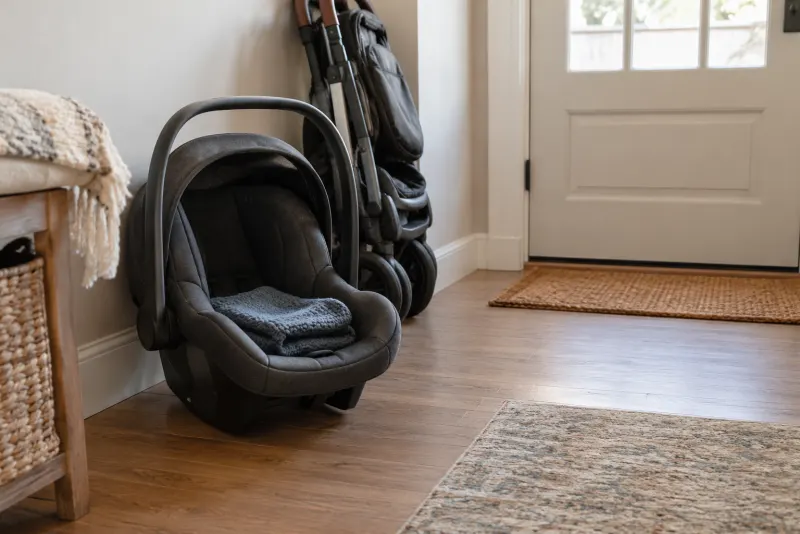
What are the five car seat stages?
NHTSA and the AAP move a child to the next stage when they outgrow the seat, not on a birthday. State laws set the legal minimum; each state's page shows how its law compares.
Rear-facing car seat
NHTSA and the AAP recommend keeping your child rear-facing as long as possible, until they reach the top height or weight limit allowed by the car seat's manufacturer. A child under age 1 should always ride rear-facing, and most convertible seats allow rear-facing for 2 years or more.
32 of 51 confirmed states set a rule for this stage
Forward-facing seat with a harness
NHTSA and the AAP recommend using a forward-facing car seat with a harness and tether once your child outgrows the rear-facing limits, for as long as possible, up to the highest weight or height the seat's manufacturer allows.
28 of 51 confirmed states set a rule for this stage
Booster seat
NHTSA and the AAP recommend using a belt-positioning booster seat after your child outgrows the harnessed seat, until the vehicle seat belt fits properly, typically when they reach about 4 feet 9 inches tall and are 8 to 12 years old.
50 of 51 confirmed states set a rule for this stage
Seat belt
NHTSA and the AAP recommend moving to the seat belt alone only when it fits: the lap belt lies snugly across the upper thighs, not the stomach, and the shoulder belt crosses the middle of the chest and shoulder, not the neck or face. Children big enough for the belt alone should always use a lap and shoulder belt.
51 of 51 confirmed states set a rule for this stage
Back seat
NHTSA and the AAP recommend keeping all children younger than 13 in the back seat.
21 of 51 confirmed states set a rule for this stage
Sources: National Highway Traffic Safety Administration; American Academy of Pediatrics (HealthyChildren.org)
What does each state's car seat law require?
Every state and DC. "Under 2" means the law requires that stage for children younger than 2; other limits the law sets are listed under the age. Tap a state for the full rule, the fine and exemptions.
| State | Rear-facing | Booster | Back seat | Fine |
|---|---|---|---|---|
| Alabama | Under 120 lb | Under 6 | No rule | $25 |
| Alaska | Under 120 lb | Under 84 ft 9 in, 65 lb | No rule | $50 |
| Arizona | No rule | Under 84 ft 9 in | No rule | $50 |
| Arkansas | No rule | Under 660 lb | No rule | $25–$100 |
| California | Under 23 ft 4 in, 40 lb | Under 84 ft 9 in | Under 8 | $100 |
| Colorado | Under 240 lb | Under 9 | Under 9 | $65 |
| Connecticut | Under 230 lb | Under 860 lb | No rule | – |
| Delaware | Under 230 lb | Required | Under 12 | None |
| District of Columbia | Under 240 lb | Under 8 | No rule | $75 |
| Florida | No rule | Under 6 | No rule | $60 |
| Georgia | No rule | Under 84 ft 9 in | Under 8 | Up to $50 |
| Hawaii | Under 2 | Under 104 ft 9 in | No rule | Up to $100 |
| Idaho | No rule | Under 7 | No rule | $84 |
| Illinois | Under 23 ft 4 in, 40 lb | Under 8 | No rule | $75 |
| Indiana | No rule | Under 8 | No rule | Up to $25 |
| Iowa | Under 120 lb | Under 6 | No rule | $135 |
| Kansas | No rule | Under 84 ft 9 in, 80 lb | No rule | $60 |
| Kentucky | No rule | Under 84 ft 9 in | No rule | $50 (car seat); $30 (booster) |
| Louisiana | Under 2 | Under 9 | Under 13 | $100 |
| Maine | Under 2 | Under 84 ft 9 in, 80 lb | Under 12 | $50 |
| Maryland | Under 2 | Under 84 ft 9 in | No rule | $50 |
| Massachusetts | No rule | Under 84 ft 9 in | No rule | Up to $25 |
| Michigan | Under 2 | Under 84 ft 9 in | Under 13 | Up to $10, plus court costs |
| Minnesota | Under 2 | Under 9 | Under 13 | Up to $50 |
| Mississippi | No rule | Under 74 ft 9 in, 65 lb | No rule | Up to $25 |
| Missouri | No rule | Under 84 ft 9 in, 80 lb | No rule | Up to $50 plus court costs |
| Montana | Under 2 | Under 9 | No rule | Up to $100 |
| Nebraska | Under 2 | Under 8 | Under 8 | $25 |
| Nevada | Under 2 | Under 64 ft 9 in | Under 2 | $100–$500 or 10–50 hours of community service |
| New Hampshire | Under 2 | Under 74 ft 9 in | No rule | $50 |
| New Jersey | Under 230 lb | Under 84 ft 9 in | Under 8 | $50–$75 |
| New Mexico | Under 1 | Under 760 lb | Under 1 | $25 |
| New York | Under 2 | Under 8 | No rule | $25–$100 |
| North Carolina | No rule | Under 880 lb | Under 5 | Up to $25 |
| North Dakota | No rule | Under 84 ft 9 in | No rule | $25 |
| Ohio | No rule | Under 84 ft 9 in | No rule | $25-$75 |
| Oklahoma | Under 2 | Under 84 ft 9 in | No rule | $50 plus court costs |
| Oregon | Under 2 | Under 84 ft 9 in | No rule | $115 |
| Pennsylvania | Under 2 | Under 8 | No rule | $75 |
| Rhode Island | Under 230 lb | Under 84 ft 9 in, 80 lb | Under 8 | $100 |
| South Carolina | Under 2 | Under 84 ft 9 in | Under 8 | up to $150 |
| South Dakota | No rule | No rule | No rule | – |
| Tennessee | Under 120 lb | Under 94 ft 9 in | Under 9 | – |
| Texas | No rule | Under 84 ft 9 in | No rule | $25-$250 |
| Utah | No rule | Under 84 ft 9 in | No rule | up to $45 |
| Vermont | Under 2 | Under 8 | Under 13 | $25 |
| Virginia | Under 2 | Under 8 | Under 8 | $50 |
| Washington | Under 2 | Under 4 ft 9 in | Under 13 | $48 base penalty plus statutory assessments |
| West Virginia | No rule | Under 84 ft 9 in | No rule | $10-$20 |
| Wisconsin | Under 120 lb | Under 84 ft 9 in, 80 lb | Under 4 | $175.30 total (child under 4); $150.10 total (ages 4-8) |
| Wyoming | No rule | Under 9 | Under 9 | up to $50 |
Booster is the age or size until which the law requires a car seat or booster seat rather than a seat belt alone. Fine is the fine for a first offense. No rule means the state's law doesn't set one for that stage. A dash means the law sets no dollar fine for a first offense; the state's page explains. Not confirmed yetmeans we couldn't verify the statute; check with the state's highway safety office.
Download this table (CSV) with every stage's limits and wording, fines, exemptions, the statute and source links for each state. Free to reuse with credit to The Mom Site (CC BY 4.0). Every state file is also in our open data on GitHub, Zenodo (doi:10.5281/zenodo.23492658) and Kaggle.
Sources: National Highway Traffic Safety Administration; American Academy of Pediatrics (HealthyChildren.org); California Legislative Information; Electronic Code of Federal Regulations. Data as of October 2026.
Where can you get your car seat checked for free?
Certified child passenger safety technicians check car seats at inspection stations nationwide. NHTSA says they inspect seats free of charge in most cases and show you how to install and use the seat correctly, and some locations offer virtual inspections. Search NHTSA's locator by ZIP code or city (it can filter for Spanish-speaking technicians), or find a technician through Safe Kids Worldwide.
Sources: National Highway Traffic Safety Administration; American Academy of Pediatrics (HealthyChildren.org)
State car seat laws set legal minimums, and many fall short of NHTSA and AAP guidance: Florida, Georgia and Indiana, for example, have no rear-facing requirement at all.
Sources: Insurance Institute for Highway Safety; National Highway Traffic Safety Administration; American Academy of Pediatrics (HealthyChildren.org)
Federal Motor Vehicle Safety Standard 213 (49 CFR 571.213) sets requirements for child restraint systems used in motor vehicles and aircraft, with the stated purpose of reducing the number of children killed or injured in crashes. Manufacturers certify their own seats: NHTSA says the seats it rates are self-certified by the manufacturer to meet federal safety standards, including strict crash performance standards. Seats manufactured on or after December 5, 2026 must meet the updated FMVSS 213b. The new side-impact standard, FMVSS 213a (for seats used by children up to 40 pounds or 43 inches), has a compliance date of December 5, 2026, after a September 9, 2026 final rule moved it from June 30, 2025.
Sources: Electronic Code of Federal Regulations; Federal Register (NHTSA); National Highway Traffic Safety Administration
The AAP says an adult seat belt fits when: the shoulder belt lies across the middle of the chest and shoulder, not the neck or throat; the lap belt is low and snug across the upper thighs, not the belly; and the child is tall enough to sit against the vehicle seat back with knees bent over the edge of the seat without slouching, and can stay that way for the whole trip. NHTSA uses the same lap-belt and shoulder-belt checks. The 5-step test, which California writes into law from January 1, 2027, asks: 1) Does the child sit all the way back against the seat? 2) Do the knees bend over the edge of the seat? 3) Does the shoulder belt snugly cross the center of the chest and shoulder, not the neck? 4) Is the lap belt as low as possible, touching the thighs? 5) Can the child stay seated like this for the whole trip?
Sources: American Academy of Pediatrics (HealthyChildren.org); National Highway Traffic Safety Administration; California Legislative Information
Questions about car seat laws
When can a child face forward in a car seat?
NHTSA and the AAP recommend keeping your child rear-facing as long as possible, until they reach the top height or weight limit allowed by the car seat's manufacturer. A child under age 1 should always ride rear-facing, and most convertible seats allow rear-facing for 2 years or more. By law, 26 of the 50 states and DC we've confirmed require rear-facing until at least age 2.
When can a child stop using a booster seat?
NHTSA and the AAP recommend using a belt-positioning booster seat after your child outgrows the harnessed seat, until the vehicle seat belt fits properly, typically when they reach about 4 feet 9 inches tall and are 8 to 12 years old. The AAP says an adult seat belt fits when: the shoulder belt lies across the middle of the chest and shoulder, not the neck or throat; the lap belt is low and snug across the upper thighs, not the belly; and the child is tall enough to sit against the vehicle seat back with knees bent over the edge of the seat without slouching, and can stay that way for the whole trip. NHTSA uses the same lap-belt and shoulder-belt checks. The 5-step test, which California writes into law from January 1, 2027, asks: 1) Does the child sit all the way back against the seat? 2) Do the knees bend over the edge of the seat? 3) Does the shoulder belt snugly cross the center of the chest and shoulder, not the neck? 4) Is the lap belt as low as possible, touching the thighs? 5) Can the child stay seated like this for the whole trip? By law, 39 of the 50 states and DC we've confirmed require a car seat or booster until at least age 8.
How old does a child have to be to sit in the front seat?
NHTSA and the AAP say every child under 13 should ride in the back seat. 21 of the 50 states and DC we've confirmed set a back-seat rule in the law.
What is the fine for breaking a car seat law?
It depends on the state. Among the 22 states and DC we've confirmed with a set first-offense fine, it runs from $25 in Alabama to $135 in Iowa. 17 of the 50 states and DC we've confirmed add points to your license.
Choosing and getting a car seat
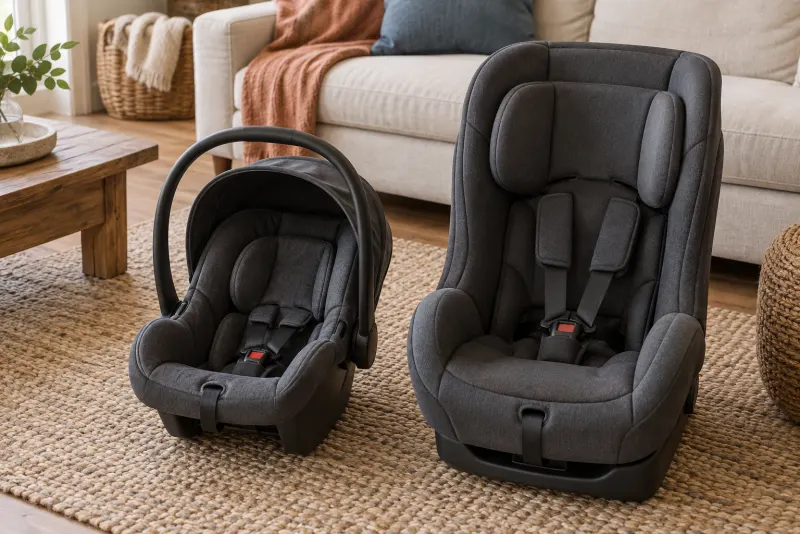 Infant vs convertible car seat: which to buy firstInfant vs convertible car seat, compared with AAP and NHTSA guidance: rear-facing limits, portability, when to switch, installation and free seat checks.
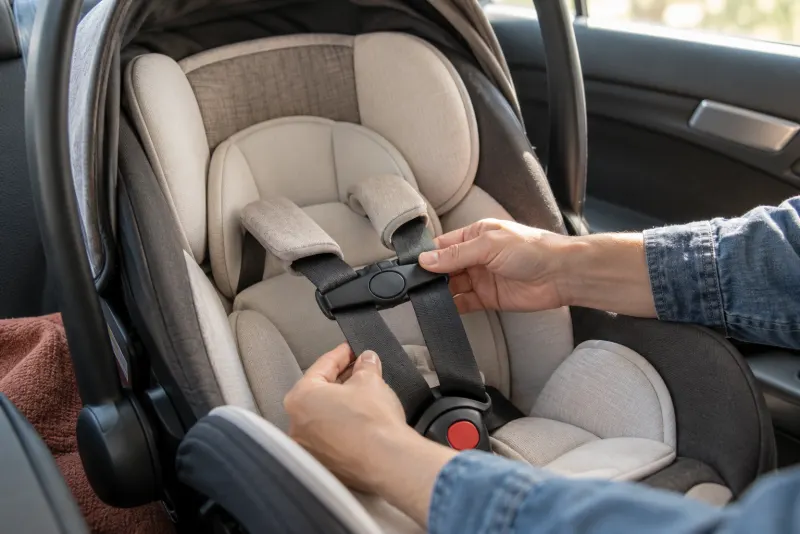 How to get a free car seatWhere to get a free infant car seat in 2026: Medicaid plan extras, Safe Kids coalitions and 211, plus free installation checks and when a used seat isn't safe.
How we built this
51
states and DC confirmed from the statute
Checked October 2026
0
not confirmed yet
Checked October 2026
23
with a set first-offense fine
From the statutes
182
sources: statutes, state agencies, NHTSA and the AAP
On each state's page
Read how we built the dataHide the method
Each state's child passenger safety law was read from the statute on the state's official legislature or code site. Where the official code host couldn't be read, we used the state's own highway safety, transportation or motor vehicle agency page, and say so in that state's sources. Multistate summaries (IIHS) were used only to find and cross-check the law; where they disagreed with the statute, the statute wins. A rule is recorded only when the law states it: rear-facing, harness, booster, seat belt and back-seat requirements, the first-offense fine and points, and exemptions.
A state we couldn't confirm is marked unverified, and its page sends readers to the statute and the state agency. Best-practice guidance comes from the National Highway Traffic Safety Administration (NHTSA) and the American Academy of Pediatrics (AAP).
Sources
- 1.Car Seats and Booster Seats National Highway Traffic Safety Administration. Accessed October 14, 2026.
- 2.Car Seats: Information for Families (last updated 4/16/2026) American Academy of Pediatrics (HealthyChildren.org). Accessed October 14, 2026.
- 3.California Vehicle Code § 27363 (exemptions; current version and version operative January 1, 2027) California Legislative Information. Accessed October 14, 2026.
- 4.Car Seat Inspection (inspection station locator) National Highway Traffic Safety Administration. Accessed October 14, 2026.
- 5.49 CFR 571.213, Standard No. 213; Child restraint systems Electronic Code of Federal Regulations. Accessed October 14, 2026.
- 6.49 CFR 571.213b, Standard No. 213b; Child restraint systems; mandatory applicability beginning December 5, 2026 Electronic Code of Federal Regulations. Accessed October 14, 2026.
- 7.Final rule: FMVSS No. 213a side impact protection; FMVSS 213 and 213b amendments (91 FR 57265, Sept. 9, 2026; effective Oct. 9, 2026) Federal Register (NHTSA). Accessed October 14, 2026.
- 8.Car Seat Ease-of-Use Ratings National Highway Traffic Safety Administration. Accessed October 14, 2026.
- 9.Seat belt and child seat laws (table dated October 2026) Insurance Institute for Highway Safety. Accessed October 14, 2026.
These are the national sources. Each state's page lists its statute and the agency pages behind its row: 182 sources across the 50 states and DC, checked October 2026.