The Mom Site · themomsite.com/gear/infant-vs-convertible-car-seat/
On this page10 sections
Key takeaways
- The AAP says the right seat is the one that fits your child's size, fits your vehicle, is installed correctly and is used on every ride. A higher price doesn't make a seat safer.
- Rear-facing-only infant seats fit babies up to 22 to 35 pounds and 26 to 35 inches, depending on the model. Many convertible seats rear-face up to 40 to 50 pounds.
- Switch out of an infant seat when your baby reaches its weight or height limit, including any head-room rule in the manual, then keep riding rear-facing in the next seat.
- Install with the seat belt or the lower anchors, not both. NHTSA says certified technicians check car seats free of charge in most cases.
- No bulky coats under the harness: buckle your baby in thin layers, then lay a coat or blanket over the straps.
At a glance
Infant car seat
Suits: Families who want a carrier that lifts out of the car and clicks into a base or stroller, and parents of very small babies.
- Strength: Lifts out with a carry handle while the base stays installed
- Strength: Extra bases make switching cars quick
- Strength: Very small babies usually fit better
- Strength: Can click into a compatible stroller
- Trade-off: Rear-facing only, outgrown at 22 to 35 pounds or 26 to 35 inches
- Trade-off: You'll need a convertible or all-in-one seat next
- Trade-off: Not a place for sleep outside the car
Convertible car seat
Suits: Families who want one seat for the rear-facing and forward-facing harness years, mostly in one car.
- Strength: Many rear-face up to 40 to 50 pounds
- Strength: Turns forward-facing with a harness later
- Strength: One purchase instead of two
- Trade-off: Bulkier, with no carry handle or separate base
- Trade-off: Some don't start until 14 or 15 pounds
- Trade-off: Moving it to another car means reinstalling it
Either type can be a safe first car seat. What matters, the American Academy of Pediatrics says, is a seat that fits your child's size, is installed correctly, fits well in your vehicle and gets used on every ride [1]. Lean toward an infant seat if you want a carrier that lifts out of the car or your baby will be very small, and toward a convertible if you'd rather buy one seat that stays put and keeps your child rear-facing longer.
We don't test car seats. This comparison draws on NHTSA, AAP, CDC and Safe Kids Worldwide guidance and the AAP's 2026 car seat listing.
What each seat is
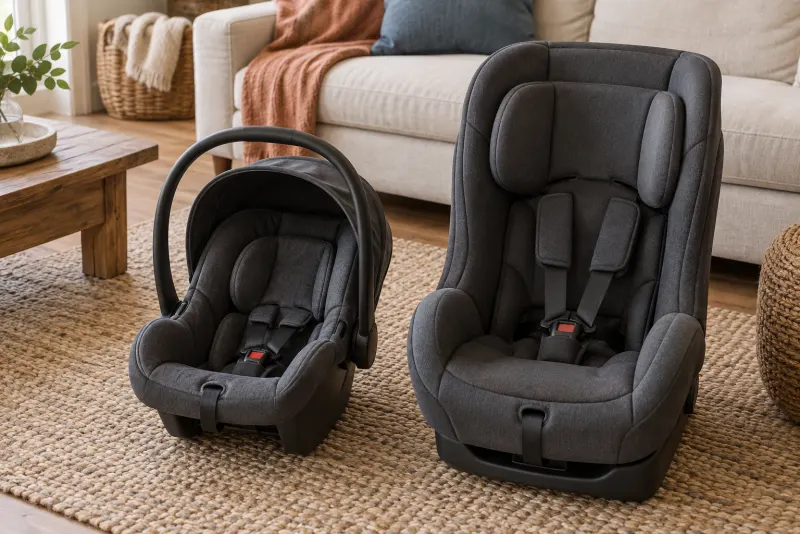
An infant car seat (the AAP calls it a rear-facing-only seat) is a small carrier with a handle. It usually comes with a base that stays installed in the car, and the carrier clicks in and out of it, so you don't reinstall the seat on every trip. You can buy extra bases for other cars [1]. It can only face the rear [2], and depending on the model, it fits babies up to 22 to 35 pounds and 26 to 35 inches [1].
A convertible car seat is installed rear-facing for a baby and later "converted" to face forward with a harness once your child outgrows the rear-facing limits. Convertibles are bulkier, have no carrying handle or separate base, and are designed to stay in the car. Many rear-face up to 40 to 50 pounds [1].
An all-in-one seat goes a step further: rear-facing, then forward-facing, then a belt-positioning booster. These are often bigger still [1]. The rear-facing points below apply to them too.
The AAP says all of them are for travel only, not for sleeping, feeding or other use outside the vehicle [1].
What the rear-facing rules say
A child under age 1 should always ride rear-facing, and NHTSA notes that convertible and all-in-one seats usually have higher rear-facing limits, so your child can stay rear-facing longer [2]. In 2018 the AAP updated its advice to rear-facing for as long as possible, until your child reaches the highest weight or height the manufacturer allows [6]. Its policy statement says every move to the next stage comes with some decrease in protection, so delay each one as long as possible [5]. Most convertibles have limits that let children ride rear-facing for 2 years or more [1], and the CDC's guidelines put rear-facing at birth until age 2 to 4 [7].
A rear-facing seat never goes in the front seat: front passenger air bags can injure or kill young children in a crash [7].
Infant vs convertible car seat: side by side
| Infant car seat | Convertible car seat | |
|---|---|---|
| Direction | Rear-facing only [2] | Rear-facing, then forward-facing with a harness [1] |
| Rear-facing limit | 22 to 35 lb and 26 to 35 in, by model [1] | Many go to 40 to 50 lb [1] |
| Starting weight (2026 AAP list) | Most 4 lb, a few 3 lb [4] | Most 4 or 5 lb, a few 14 or 15 lb [4] |
| Portability | Carrier with a handle; base stays in the car [1] | Stays installed; no handle or base [1] |
| Strollers | Can click into a compatible stroller, sold together as a "travel system" [4] | Stays in the car |
| A second car | Buy an extra base [1] | Buy a second seat or reinstall |
| Seats for the harness years | Two: infant seat, then a convertible or all-in-one [1] | One |
| Small or preterm babies | Very small babies usually fit better [1] | Check the minimum weight and harness slots |
In the AAP's 2026 listing, most infant seats are rated to 30 or 35 pounds and about 30 to 32 inches, and a handful stop at 22 pounds [4]. The few convertibles that start at 14 or 15 pounds matter if you plan to use one from birth. Your own seat's label and manual are the final word. And the AAP is blunt about price: a higher price does not mean a seat is safer or easier to use [1].
When to switch from an infant car seat
Switch when your baby reaches the infant seat's maximum weight or its maximum height, whichever comes first. The manual for one widely sold infant seat, Chicco's KeyFit 30, says to stop using it as soon as the child reaches either limit [8]. We cite it as an example of how manuals word this, not as a pick. What your state's law requires at each stage is on our car seat laws by state page.
Most manuals add rules beyond the two numbers:
- Head room. Many seats require space above your baby's head. The KeyFit 30 manual, for example, limits use to babies 4 to 30 pounds and 30 inches or less, with the top of the head at least 1 inch below the top of the headrest [8]. Seats in the AAP's 2026 listing measure that inch to different points, such as the top of the carrier, the seat back or the headrest adjuster [4], so follow your own manual rather than a rule of thumb.
- Harness height. Rear-facing, the harness straps go through the slots at or below your child's shoulders [3]. Some manuals make this a condition of use [8].
When your baby outgrows the infant seat, move to a convertible or all-in-one seat and keep it rear-facing [1]. NHTSA says that if a baby under 1 grows too tall or too heavy for an infant seat, a seat with a higher rear-facing limit is strongly recommended [3]. Turning forward early isn't an upgrade; it's one of the transitions the AAP says to put off [5].
Not sure your baby has outgrown it? A certified child passenger safety technician can check the fit with you.
Fit to your car and installation
NHTSA's order: choose a seat for your child's age and size, then choose one that fits your vehicle, and use it every time. Not all car seats fit in all vehicles, so NHTSA suggests testing the seat you plan to buy in your car. Read both the seat's instructions and your vehicle owner's manual before you install [2].
Seat belt or lower anchors (LATCH). Install with either the lower anchors or the vehicle seat belt, never both [2]. The AAP says the two methods are equally safe, so use whichever works for your seat and your car, and only use both if the seat and vehicle manufacturers say it's OK [1]. With a seat belt, you have to lock it, using the vehicle's belt system or the seat's lock-off [3].
Lower anchors have their own weight limit, which matters most with convertibles. If your seat's label doesn't show it, NHTSA's formula is 65 pounds minus the seat's weight; past that, reinstall with the seat belt [2].
How to tell it's tight. At the belt path, the seat shouldn't move more than 1 inch side to side or front to back. Check the recline with the seat's angle indicator, and expect to adjust it as your baby grows [3].
Where it goes. In the back seat. NHTSA recommends keeping children in the back seat at least through age 12 [2].
Get it checked for free
Safe Kids Worldwide says more than half of car seats are not used or installed correctly [9]. NHTSA's inspection station locator searches by zip code. Certified technicians inspect seats free of charge in most cases and show you how to install and use yours, and some offer virtual or Spanish-language help. No station nearby? NHTSA suggests finding a technician through Safe Kids [2].
The AAP suggests working with a certified child passenger safety technician before your baby is born [1]. Add it to your pregnancy timeline so the seat is in and checked before the drive home on your hospital bag checklist.
Expiration dates, used seats and recalls
Expiration. Look on the label for the date the seat was made, and check with the manufacturer for how long it recommends using it [1]. Lifespans vary by model. The KeyFit 30 manual, for example, says not to use that seat once it's more than 6 years old and points to a "Do Not Use After" date on the underside [8]. Our guide to car seat expiration dates by brand compares makers.
Used seats and crash history. NHTSA says a second-hand seat may be okay only if it has never been in a moderate to severe crash, has its date and model labels, has no recalls, has all its parts and has its instructions [11]. Never use a seat that's been in a moderate or severe crash [12], and some manufacturers want a seat replaced after any crash [1]. If you don't know a seat's history, the AAP says to avoid it [1]. Our guide to getting a free car seat covers NHTSA's minor-crash test and where to find a seat at no cost.
Recalls. Register your seat with the manufacturer, by mailing the card that came with it or online, so the company can reach you about recalls [2]. Look up your seat in NHTSA's recall search; NHTSA suggests checking twice a year [13]. It also sends car seat recall alerts by email and through its free SaferCar app [2], and its Vehicle Safety Hotline is 888-327-4236 [1].
Coats, blankets and add-ons
Bulky clothing, including winter coats and snowsuits, can compress in a crash and leave the harness too loose [1]. Dress your baby in thin layers, buckle the harness, then lay a blanket over the straps or put the coat on backwards over the buckled harness [10].
Two quick checks after buckling:
- Pinch test. Try to pinch the harness strap at your baby's shoulder. If you can pinch extra material, tighten it [3][10].
- Chest clip at armpit level [3].
Skip add-ons. The AAP says not to use any insert unless it came with the seat or the manufacturer made it for that seat [1], and to use a car seat cover only if it has no layer under the baby [10]. For a tiny baby who needs support, NHTSA says you can use small rolled blankets on each side of the shoulders and head, but no thick padding under or behind the baby unless the manufacturer recommends it [3].
Outside the car. The carrier is handy for getting a baby in and out, but it isn't a bed. If your baby falls asleep in a car seat, the AAP says to move them to a firm sleep surface, on their back, as soon as possible [14]. Carriers can also roll over on soft surfaces, which is why the KeyFit 30 manual warns never to set one on a bed or sofa [8].
Which to buy first: four situations
These are things to weigh, not rules. Any seat that fits your child, fits your car and is installed correctly is a sound choice [1]. Once you've picked a type, our guides to infant car seats and convertible car seats compare models by use case.
You live in a city and get around by taxi, rideshare and stroller
Portability favors an infant seat: the carrier lifts out, and some click into a compatible stroller [4]. Some infant seats can also be installed with the vehicle seat belt and no base. The KeyFit 30 manual includes those steps and warns never to use a non-locking belt [8], so check whether your seat allows it and practice before your due date. A convertible is bulkier and designed to stay in one car [1]. An inspection station technician can walk you through a seat belt install [2].
You have one car and a tight budget
A convertible from birth can cover the rear-facing and forward-facing harness years with one seat, instead of an infant seat followed by a convertible [1]. Before you buy, check that its rear-facing minimum covers a newborn (some start at 14 or 15 pounds [4]) and that its lowest harness slots sit at or below a newborn's shoulders [3]. Paying more won't buy a safer seat [1]. If money is tight, see our guide to free car seat programs and our list of free baby stuff from real programs.
Your baby is premature or very small
The seat must be approved for your baby's weight, and the AAP says very small babies who can sit safely semi-reclined usually fit better in rear-facing-only seats [1]. Babies born preterm should be screened in the hospital to make sure they can sit safely semi-reclined, and babies who need to lie flat may be able to ride in a car bed that meets Federal Motor Vehicle Safety Standard 213 [1]. Most infant seats in the AAP's listing start at 4 pounds and a few at 3 [4], and the KeyFit 30 manual tells parents of premature infants to consult the baby's doctor before using it [8]. Ask your NICU team about screening before discharge, and have a certified technician check the fit.
Two cars or two drivers
If two caregivers drive different cars every day, an infant seat with an extra base saves reinstalls [1]. A convertible means a second seat or a reinstall each time. For the rest of your shopping list, see our baby registry checklist and newborn checklist.
Buying an infant seat with a stroller? See car seat and stroller combos.
Questions people ask
Is it better to get an infant car seat or a convertible car seat?
Neither type is safer by design. The AAP says the right seat fits your child's size and your car and is installed and used correctly every time. Infant seats are more portable; convertibles last longer and keep children rear-facing to higher limits.
When should I switch from an infant car seat to a convertible?
When your baby reaches the infant seat's maximum weight or maximum height, whichever comes first, or no longer meets the head-room rule in its manual. Move to a convertible or all-in-one seat and keep it rear-facing.
Can a newborn ride in a convertible car seat?
Yes, if the seat's rear-facing minimum covers your baby's weight and height and the harness fits. In the AAP's 2026 listing, most convertibles start at 4 or 5 pounds, but a few start at 14 or 15 pounds, so check the label.
How long should my baby ride rear-facing?
As long as possible, until your child reaches the highest rear-facing weight or height the seat allows. The AAP updated its advice to this in 2018, and most convertible seats let children ride rear-facing past their second birthday.
Are LATCH and seat belt installations equally safe?
Yes. The AAP says they're equally safe, so use whichever gives a tight install in your car. Don't use both at once unless the car seat and vehicle manufacturers say it's OK.
Can my baby wear a winter coat in the car seat?
Not under the harness. Bulky coats compress in a crash and leave the straps too loose. Dress your baby in thin layers, buckle the harness, then put a coat or blanket over the straps.
Sources
Numbers in brackets in the guide link to these sources.
- 1.Car Seats: Information for FamiliesAmerican Academy of Pediatrics (HealthyChildren.org), 2026
- 2.Car Seats and Booster SeatsNational Highway Traffic Safety Administration (NHTSA), 2026
- 3.How to Install Rear-Facing Car SeatsNational Highway Traffic Safety Administration (NHTSA), 2026
- 4.Car Seats: Product Listing for 2026American Academy of Pediatrics (HealthyChildren.org), 2026
- 5.Child Passenger Safety (policy statement), Pediatrics 142(5):e20182460American Academy of Pediatrics, Council on Injury, Violence, and Poison Prevention (via PubMed), 2018
- 6.How long should my child ride rear facing?American Academy of Pediatrics (HealthyChildren.org), 2020
- 7.Child Passenger SafetyCenters for Disease Control and Prevention (CDC), 2026
- 8.KeyFit 30 Car Seat User Guide (03/2020)Chicco USA (Artsana USA), 2020
- 9.Car Seat SafetySafe Kids Worldwide, 2026
- 10.Winter Car Seat Safety Tips from the AAPAmerican Academy of Pediatrics (HealthyChildren.org), 2025
- 11.Used Car Seat Safety ChecklistNational Highway Traffic Safety Administration (NHTSA), 2026
- 12.Car Seat Use After a CrashNational Highway Traffic Safety Administration (NHTSA), 2026
- 13.Check for Recalls: Vehicle, Car Seat, Tire, EquipmentNational Highway Traffic Safety Administration (NHTSA), 2026
- 14.How to Keep Your Sleeping Baby Safe: AAP Policy ExplainedAmerican Academy of Pediatrics (HealthyChildren.org), 2026