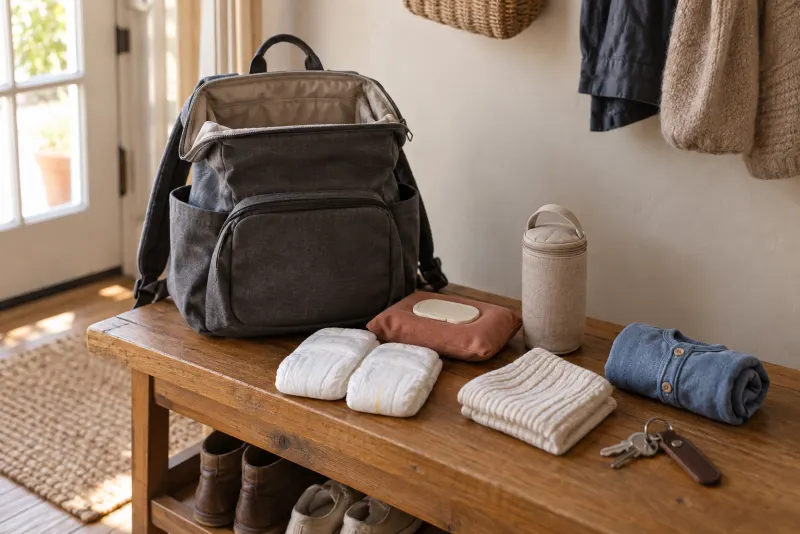
52 items. Tick them off here, or print it and take it with you.
The Mom Site · themomsite.com/gear/diaper-bag-checklist/
On this page11 sections
Key takeaways
- Infants can go through up to 12 diapers a day, so pack about one diaper for every two hours out, plus two spares (our estimate).
- The CDC says breast milk keeps up to 4 hours at 77°F or colder, and up to 24 hours in an insulated cooler with frozen ice packs.
- The CDC says to use mixed formula within 2 hours of making it and within 1 hour of when the feeding starts, so carry powder and water separately and mix at feeding time.
- The AAP says to keep babies under 6 months out of direct sun, with shade and clothing first, and sunscreen on small areas like the face only if those aren't available.
- Bulky coats and snowsuits don't go under car seat straps. Buckle the harness snugly over thin layers, then add a blanket on top.
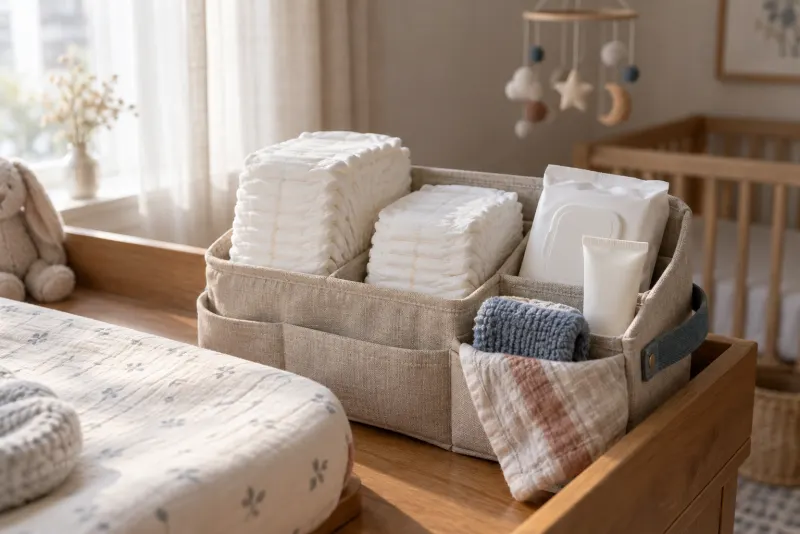
A diaper bag needs a small core that never leaves it: diapers, wipes, a changing pad, a change of clothes, hand sanitizer and whatever your baby eats. Infants can go through up to 12 diapers a day [1], so for a newborn, pack about one diaper for every two hours you'll be out, plus two spares. Then add to it by age, trip length and weather.
We built this list from CDC, AAP, FDA and NHTSA guidance. We don't test bags or recommend brands, and quantities are our estimates unless they carry a citation. For delivery day, see the hospital bag checklist, and for what to have at home, the newborn checklist.
Diaper bag essentials: the everyday core
These items stay in the bag at every age. If you're still choosing a bag and a changing pad, add them to your baby registry checklist.
The CDC also says to wash your hands and your child's hands with soap and water after a diaper change [2]. Sanitizer is the backup, and it works less well on visibly dirty or greasy hands [3].
Still choosing a bag? See diaper bags by use.
What to add by age
The core stays the same. Feeding, entertainment and the diaper count change.
Newborn (birth to about 3 months)
A breastfed newborn feeds about 8 to 12 times in 24 hours, and most exclusively breastfed babies feed every 2 to 4 hours [4]. Plan on one feed for every two to three hours away.
If your baby falls asleep in the car seat or stroller, the AAP says to move them to a firm sleep surface on their back as soon as possible [6].
About 6 months
The AAP recommends only breast milk for about the first 6 months, then adding foods alongside it [7]. That's when a spoon and cup join the bag. Ask your pediatrician when your baby is ready for solids.
Toddler (1 to 3 years)
Toddlers use fewer diapers. The National Diaper Bank Network says most child care centers ask for a day's supply of four to six changes [1], a fair benchmark for a full day out.
Quick errand vs full day
A quick trip needs only the core. A full day needs more of what gets used up.
| Item | Quick errand (1 to 2 hours) | Full day (6 to 8 hours) |
|---|---|---|
| Diapers, newborn | 3 | 5 to 6 [1] |
| Diapers, toddler | 1 to 2 | 4 to 6 [1] |
| Feeds, newborn | 1 | 1 for every 2 to 3 hours, plus 1 [4] |
| Baby outfits | 1 | 2 |
| Cooler and ice packs | Optional below 77°F [9] | Yes, for pumped milk [9] |
Counts are our estimates, scaled from the cited daily figures.
Feeding on the go
Breast milk
The CDC's storage times for pumped milk [9]:
| Where | How long |
|---|---|
| Room temperature, 77°F or colder | Up to 4 hours |
| Insulated cooler with frozen ice packs | Up to 24 hours |
| Left in the bottle after a feeding | Use within 2 hours, then throw out |
| Thawed, then warmed or at room temperature | Use within 2 hours; never refreeze |
To plan sessions around outings, see our pumping schedule guide, or pumping at work if you're back on the job. If feeding away from home is hard, a lactation consultant can help.
Formula
The CDC says to use prepared formula within 2 hours of making it and within 1 hour of when the feeding starts, and to throw out what's left in the bottle [10]. So carry the powder and water separately and mix at feeding time.
If you mix a bottle and won't use it within 2 hours, the CDC says to put it in the fridge right away and use it within 24 hours [10]. If formula costs are a strain, see whether you qualify for WIC.
Weather and sun
Babies under 6 months need shade more than sunscreen. The AAP says to keep them out of direct sunlight, find shade under a tree, an umbrella or the stroller canopy, and use sunscreen on small areas such as the face only if protective clothing and shade aren't available [12]. The FDA says to ask a doctor before using sunscreen on a baby under 6 months [13].
The car kit
A backup stash in the car covers forgotten items. NHTSA suggests keeping an emergency bag in your vehicle with blankets, a phone charger, food and water [15].
Leave unopened formula out of the car kit. The CDC says to store it in a cool, dry, indoor place, not in vehicles [10].
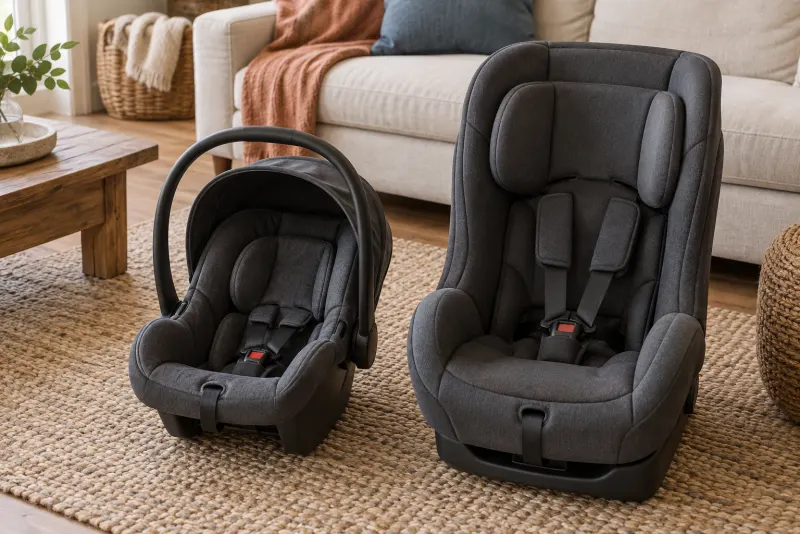
In winter, dress your child in thin layers such as fleece, buckle the harness snugly, then add a blanket or put the coat on backward over the straps [15][16]. The AAP's check: if you can pinch the harness strap, tighten it [16]. It also suggests keeping an infant seat's carrier indoors between trips so it starts at room temperature [16]. Choosing a seat? See infant vs convertible car seats and our infant car seat guide. And never leave a child alone in or around a car, even briefly. The AAP warns temperatures can reach deadly levels in minutes [17].
What not to pack
- Medicine without a dose from your pediatrician. The AAP says to call your pediatrician before giving acetaminophen to a child under 2, and to use only the dosing device that comes with the product [18]. The FDA doesn't recommend over-the-counter cough and cold medicines for children under 2 [19].
- A pacifier on a string around the neck or wrist. The AAP says never to tie a pacifier around your child's neck or hand [20].
- Car seat add-ons that didn't come with the seat. The AAP says not to use extra products unless they came with the seat or the seat's manufacturer specifically approves them [17].
- Choking-risk snacks for kids under 4. Whole grapes, popcorn, nuts and seeds, hot dogs, raw carrot sticks and chunks of cheese are on the AAP's list to hold back or cut up, and children should sit down when they eat [8].
- Premixed formula at room temperature. The CDC says to use prepared formula within 2 hours of making it, or refrigerate it right away [10].
- Expired sunscreen. The FDA says a sunscreen with no expiration date should be considered expired three years after purchase [13].
- Sanitizer where a toddler can reach it. The CDC says to supervise young children using hand sanitizer so they don't swallow the alcohol [3].
Restock routine
Restock the night before, not on the way out.
After every outing
Once a month
Every season
If diapers are stretching your budget, our guide to free diapers lists diaper banks and other programs.
Questions people ask
What should be in a diaper bag for a newborn?
Diapers, wipes, a changing pad, two changes of clothes, burp cloths, hand sanitizer, an extra layer and everything for at least one feed. Newborns feed about 8 to 12 times in 24 hours, so plan on one feed for every two to three hours you're away.
How many diapers should I pack in a diaper bag?
For a newborn, about one for every two hours you'll be gone plus two spares, since infants can use up to 12 a day. For a toddler's full day, four to six is a fair benchmark: it's the day's supply most child care centers ask parents to send.
How do I keep breast milk cold in a diaper bag?
Use an insulated cooler bag with frozen ice packs. The CDC says breast milk can be stored that way for up to 24 hours when traveling, or for up to 4 hours at room temperature of 77°F or colder.
Can I make formula bottles ahead of time for an outing?
It's safer to carry premeasured powder and water separately. The CDC says to use prepared formula within 2 hours of making it, or to refrigerate it right away and use it within 24 hours.
Should I keep fever medicine in the diaper bag?
Only with a dose your pediatrician has given you. The AAP says to call your pediatrician before giving acetaminophen to a child under 2, and to use only the dosing device that comes with the product.
Can babies under 6 months wear sunscreen?
Shade and clothing come first. The AAP says to keep babies younger than 6 months out of direct sunlight and to use sunscreen on small areas, such as the face, only if protective clothing and shade aren't available. The FDA says to ask a doctor first.
Sources
Numbers in brackets in the guide link to these sources.
- 1.What is diaper need? (June 2024)National Diaper Bank Network, 2024
- 2.Healthy Habits: Diaper Changing Steps at HomeCenters for Disease Control and Prevention (CDC), 2024
- 3.Hand Sanitizer Guidelines and RecommendationsCenters for Disease Control and Prevention (CDC), 2024
- 4.How Much and How Often to BreastfeedCenters for Disease Control and Prevention (CDC), 2026
- 5.Tips for Dressing Your BabyAmerican Academy of Pediatrics (HealthyChildren.org)
- 6.How to Keep Your Sleeping Baby Safe: AAP Policy ExplainedAmerican Academy of Pediatrics (HealthyChildren.org), 2026
- 7.When Can Babies Start Solid Foods? Readiness & Feeding TipsAmerican Academy of Pediatrics (HealthyChildren.org), 2026
- 8.Choking Prevention for Babies & Children: What Every Parent Needs to KnowAmerican Academy of Pediatrics (HealthyChildren.org), 2026
- 9.Breast Milk Storage and PreparationCenters for Disease Control and Prevention (CDC), 2026
- 10.Infant Formula Preparation and StorageCenters for Disease Control and Prevention (CDC), 2026
- 11.How to Safely Prepare Baby Formula With WaterAmerican Academy of Pediatrics (HealthyChildren.org), 2026
- 12.Sun Safety: Information for Parents About Sunburn & SunscreenAmerican Academy of Pediatrics (HealthyChildren.org), 2024
- 13.Sunscreen: How to Help Protect Your Skin from the SunU.S. Food and Drug Administration (FDA), 2026
- 14.How to Choose an Insect Repellent for Your ChildAmerican Academy of Pediatrics (HealthyChildren.org), 2024
- 15.Keep Your Little Ones Warm and Safe in Their Car SeatsNational Highway Traffic Safety Administration (NHTSA), 2026
- 16.Winter Car Seat Safety Tips: Keeping Kids Safe & WarmAmerican Academy of Pediatrics (HealthyChildren.org), 2025
- 17.Car Seats: Information for FamiliesAmerican Academy of Pediatrics (HealthyChildren.org), 2026
- 18.Fever and Pain Medicine: How Much to Give Your ChildAmerican Academy of Pediatrics (HealthyChildren.org)
- 19.Should You Give Kids Medicine for Coughs and Colds?U.S. Food and Drug Administration (FDA), 2024
- 20.Baby Pacifiers & Thumb Sucking: What Parents Need to KnowAmerican Academy of Pediatrics (HealthyChildren.org), 2026