Car seat laws in Alaska
What Alaska law requires at each stage, from rear-facing to the front seat, next to what NHTSA and the AAP recommend. Plus the fine and where to get a free car seat check.
Checked October 2026 · 10 sources · Not legal advice
Short answer
Sources: Alaska State Legislature; Alaska Court System. Data as of October 2026.
What does Alaska car seat law require at each age?
The law sets the minimum. NHTSA and the AAP recommend keeping each stage until your child outgrows the seat, which usually means longer.
| Stage | What Alaska law requires | NHTSA and AAP guidance |
|---|---|---|
Rear-facing car seatBest practice goes further | A child less than one year old, or one year or older who weighs less than 20 pounds, must ride in a rear-facing child safety seat used according to the manufacturer's instructions. | NHTSA and the AAP recommend keeping your child rear-facing as long as possible, until they reach the top height or weight limit allowed by the car seat's manufacturer. A child under age 1 should always ride rear-facing, and most convertible seats allow rear-facing for 2 years or more. |
Forward-facing seat with a harnessBest practice goes further | A child one year or older but under four who weighs 20 pounds or more must ride in a child restraint device used according to the manufacturer's instructions. The law doesn't specify a harness. | NHTSA and the AAP recommend using a forward-facing car seat with a harness and tether once your child outgrows the rear-facing limits, for as long as possible, up to the highest weight or height the seat's manufacturer allows. |
Booster seatBest practice goes further | A child over four but under eight who is under 57 inches tall and weighs at least 20 but less than 65 pounds must ride in a booster seat secured by a seat belt, or in another child restraint system. | NHTSA and the AAP recommend using a belt-positioning booster seat after your child outgrows the harnessed seat, until the vehicle seat belt fits properly, typically when they reach about 4 feet 9 inches tall and are 8 to 12 years old. |
Seat belt | A child over four who exceeds the booster height or weight limits (57 inches or 65 pounds) must wear a seat belt. Children 8 to 15 who are still under those limits ride in a child safety device or a seat belt, whichever the driver decides is appropriate. | NHTSA and the AAP recommend moving to the seat belt alone only when it fits: the lap belt lies snugly across the upper thighs, not the stomach, and the shoulder belt crosses the middle of the chest and shoulder, not the neck or face. Children big enough for the belt alone should always use a lap and shoulder belt. |
Back seatNo state rule | Alaska law doesn't say where in the car a child must sit. | NHTSA and the AAP recommend keeping all children younger than 13 in the back seat. |
The law: Alaska Stat. § 28.05.095.
Sources: Alaska State Legislature; Alaska Court System; Alaska Highway Safety Office, Department of Transportation & Public Facilities; Insurance Institute for Highway Safety. Data as of October 2026.
What are the fines and exemptions in Alaska?
First offense
$50
The court bail schedule sets $50 for failing to provide a child safety device and $50 for failing to properly secure a child in one. A first charge for failing to provide a device may be dismissed on proof of correction; a second or later charge may not.
Exemptions
School buses (unless federally required to have belts), emergency vehicles, mail and newspaper delivery from inside the vehicle, vehicles not equipped with seat belts, people exempted by regulation, and motorcycles, off-highway vehicles and similar vehicles.
Questions about the law
This is general information, not legal advice. For how the law applies to you, ask Alaska Highway Safety Office (Department of Transportation & Public Facilities).
Statute text from the Legislature's Alaska Statutes 2025. Fine from Administrative Rule 43.1 (the Court System's traffic bail schedule). Driver's-license points are not confirmed. The date of the last amendment is not confirmed. No 2026 amendment found. The Highway Safety Office page is old and has no law summary. GHSA's summary ('1 yr to under 5 yrs in an appropriate car seat or booster', '5 to under 8 yrs' booster) does not match the statute, which sets the car seat tier at 1 to under 4 and the booster tier at over 4 to under 8.
Where can you get your car seat checked for free?
Certified child passenger safety technicians check car seats at inspection stations nationwide. NHTSA says they inspect seats free of charge in most cases and show you how to install and use the seat correctly, and some locations offer virtual inspections. Search NHTSA's locator by ZIP code or city (it can filter for Spanish-speaking technicians), or find a technician through Safe Kids Worldwide.
Sources: National Highway Traffic Safety Administration; American Academy of Pediatrics (HealthyChildren.org)
Where are the car seat inspection stations in Alaska?
NHTSA's locator lists 24 car seat inspection stations in Alaska, in 19 cities and towns. Anchorage has the most (3), then Fairbanks, Kenai and Soldotna (2 each).
24
inspection stations in NHTSA's locator
NHTSA, October 2026
19
cities and towns with a station
NHTSA, October 2026
0
flagged as Spanish-speaking; ask when you call
NHTSA, October 2026
20
of 24 records updated since 2023
Newest: November 30, 2023
Cities with the most stations
- Anchorage3 stations
- Fairbanks2 stations
- Kenai2 stations
- Soldotna2 stations
Plus 15 more cities and towns. Search NHTSA's locator by ZIP code for the ones near you.
Source: National Highway Traffic Safety Administration. Data as of October 2026.
Choosing and getting a car seat
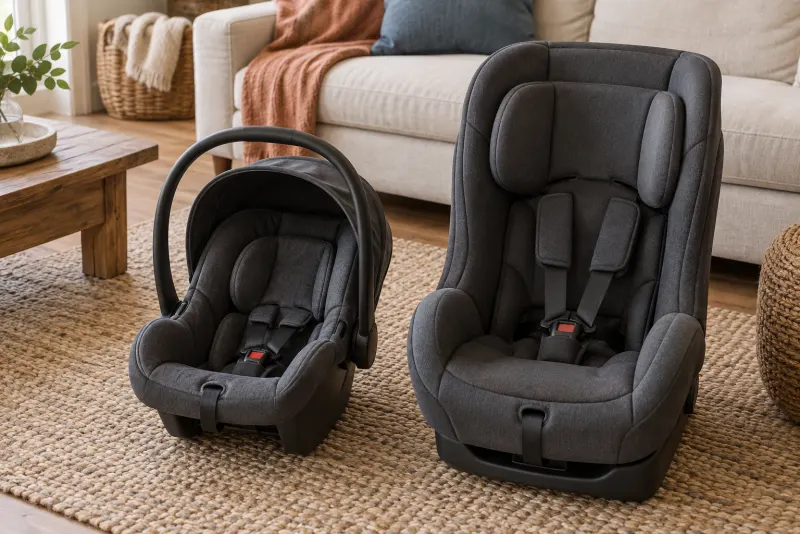 Infant vs convertible car seat: which to buy firstInfant vs convertible car seat, compared with AAP and NHTSA guidance: rear-facing limits, portability, when to switch, installation and free seat checks.
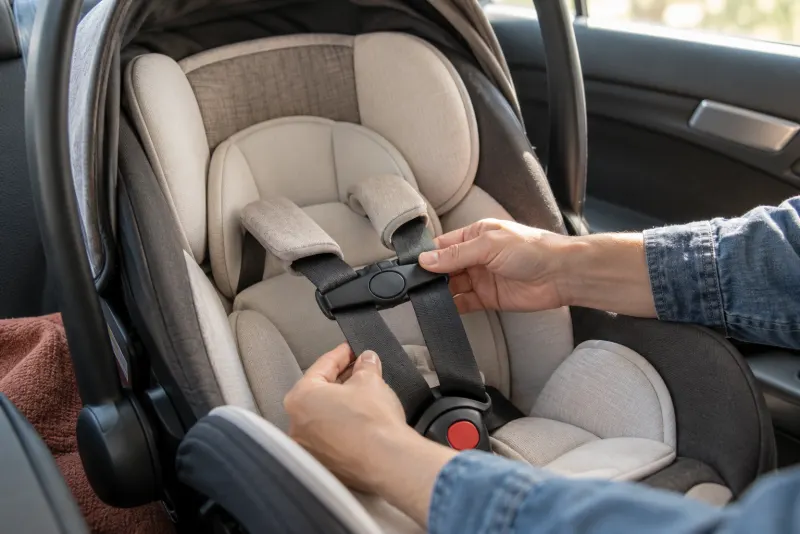 How to get a free car seatWhere to get a free infant car seat in 2026: Medicaid plan extras, Safe Kids coalitions and 211, plus free installation checks and when a used seat isn't safe.
Questions about car seat laws in Alaska
When can a child face forward in a car seat in Alaska?
A child less than one year old, or one year or older who weighs less than 20 pounds, must ride in a rear-facing child safety seat used according to the manufacturer's instructions. NHTSA and the AAP recommend going further: keeping your child rear-facing as long as possible, until they reach the top height or weight limit allowed by the car seat's manufacturer. A child under age 1 should always ride rear-facing, and most convertible seats allow rear-facing for 2 years or more.
When can a child stop using a booster seat in Alaska?
A child over four but under eight who is under 57 inches tall and weighs at least 20 but less than 65 pounds must ride in a booster seat secured by a seat belt, or in another child restraint system. NHTSA and the AAP recommend going further: using a belt-positioning booster seat after your child outgrows the harnessed seat, until the vehicle seat belt fits properly, typically when they reach about 4 feet 9 inches tall and are 8 to 12 years old. The AAP says an adult seat belt fits when: the shoulder belt lies across the middle of the chest and shoulder, not the neck or throat; the lap belt is low and snug across the upper thighs, not the belly; and the child is tall enough to sit against the vehicle seat back with knees bent over the edge of the seat without slouching, and can stay that way for the whole trip. NHTSA uses the same lap-belt and shoulder-belt checks. The 5-step test, which California writes into law from January 1, 2027, asks: 1) Does the child sit all the way back against the seat? 2) Do the knees bend over the edge of the seat? 3) Does the shoulder belt snugly cross the center of the chest and shoulder, not the neck? 4) Is the lap belt as low as possible, touching the thighs? 5) Can the child stay seated like this for the whole trip?
How old does a child have to be to sit in the front seat in Alaska?
Alaska law doesn't say where in the car a child must sit. NHTSA and the AAP recommend keeping all children younger than 13 in the back seat.
What is the fine for a car seat violation in Alaska?
The court bail schedule sets $50 for failing to provide a child safety device and $50 for failing to properly secure a child in one. A first charge for failing to provide a device may be dismissed on proof of correction; a second or later charge may not.
Where can I get a car seat inspection in Alaska?
NHTSA's locator lists 24 car seat inspection stations in Alaska, in 19 cities and towns. Anchorage has the most (3), then Fairbanks, Kenai and Soldotna (2 each). Certified technicians check seats for free in most cases. Search NHTSA's locator by ZIP code and call the station before you go.
More for parents in Alaska
Sources
- 1.Alaska Statutes § 28.05.095, Use of seat belts and child safety devices required (Alaska Statutes 2025) Alaska State Legislature. Accessed October 14, 2026.
- 2.Alaska Administrative Rule 43.1, Traffic Bail Forfeiture Schedule Alaska Court System. Accessed October 14, 2026.
- 3.Occupant Protection Alaska Highway Safety Office, Department of Transportation & Public Facilities. Accessed October 14, 2026.
- 4.Seat belt and child seat laws (table dated October 2026) Insurance Institute for Highway Safety. Accessed October 14, 2026.
- 5.Child Passenger Safety state laws (last updated October 2025) Governors Highway Safety Association. Accessed October 14, 2026.
- 6.Car Seats and Booster Seats National Highway Traffic Safety Administration. Accessed October 14, 2026.
- 7.Car Seats: Information for Families (last updated 4/16/2026) American Academy of Pediatrics (HealthyChildren.org). Accessed October 14, 2026.
- 8.California Vehicle Code § 27363 (exemptions; current version and version operative January 1, 2027) California Legislative Information. Accessed October 14, 2026.
Show all 10 sourcesShow fewer sources
- 9.Car Seat Inspection (inspection station locator) National Highway Traffic Safety Administration. Accessed October 14, 2026.
- 10.Car Seat Inspection Locator API (CSSIStation) National Highway Traffic Safety Administration. Accessed October 16, 2026.
Car seat laws in other states
- Alabama
- Arizona
- Arkansas
- California
- Colorado
- Connecticut
- Delaware
- District of Columbia
- Florida
- Georgia
- Hawaii
- Idaho
- Illinois
- Indiana
- Iowa
- Kansas
- Kentucky
- Louisiana
- Maine
- Maryland
- Massachusetts
- Michigan
- Minnesota
- Mississippi
- Missouri
- Montana
- Nebraska
- Nevada
- New Hampshire
- New Jersey
- New Mexico
- New York
- North Carolina
- North Dakota
- Ohio
- Oklahoma
- Oregon
- Pennsylvania
- Rhode Island
- South Carolina
- South Dakota
- Tennessee
- Texas
- Utah
- Vermont
- Virginia
- Washington
- West Virginia
- Wisconsin
- Wyoming