The Mom Site · themomsite.com/gear/maxi-cosi-vs-nuna-car-seats/
On this page9 sections
Key takeaways
- Every car seat sold in the US has to meet the same federal standard, FMVSS 213, so neither brand is safer by name. Fit in your car and a correct install on every ride matter more [1][2].
- Maxi-Cosi's Peri 180, Mico Pro and Mico Pro+ take babies 4 to 30 pounds and up to 32 inches. Nuna's PIPA aire rx and PIPA rx take 4 to 30 pounds and 16 to 30 inches [3][5][10][11].
- Carrier weight is Nuna's edge: 6.2 pounds for the PIPA aire rx and 7.6 for the PIPA rx, against under 8 pounds for the Peri 180 without its canopy and inserts [3][10][11].
- Maxi-Cosi infant seats expire 8 years after manufacture and Pria and Romi 10. Nuna's RAVA next and EXEC next are 10; the PIPA manuals say to read the label [4][8][17][18][12].
- Recalls we found by October 16, 2026: six Maxi-Cosi campaigns since 2010, none naming a current Peri 180, Mico Pro, Pria or Romi, and one Nuna campaign, the 2024 RAVA harness adjuster recall [19][21][22][23][24][25][26].
At a glance
Maxi-Cosi (Peri 180, Mico Pro, Pria, Romi)
Suits: Parents who want a rotating infant base, or an all-in-one that carries a child from birth to a booster.
- Strength: Peri 180 base rotates 180 degrees and has a load leg
- Strength: Pria runs from 5 lb rear-facing to a 100 lb booster
- Strength: Mico bases are sold separately for a second car
- Strength: Infant seats last 8 years, Pria and Romi 10
- Trade-off: Pria and Romi rear-face to 40 lb, 10 lb under the RAVA next
- Trade-off: Six NHTSA recall campaigns since 2010 name Maxi-Cosi, including older base and Pria models
- Trade-off: Peri 180 carrier is nearly 8 lb before the baby goes in
Nuna (PIPA aire rx, PIPA rx, RAVA next, EXEC next)
Suits: Parents who want the lightest infant carrier and a convertible that rear-faces to 50 pounds.
- Strength: PIPA aire rx carrier is 6.2 lb
- Strength: PIPA seats install without a base in two ways
- Strength: RAVA next and EXEC next rear-face to 50 lb
- Strength: Two bases fit every PIPA series seat
- Trade-off: PIPA height limit is 30 in, 2 in under Maxi-Cosi's infant seats
- Trade-off: Nuna's PIPA manuals don't print a lifespan; read the label
- Trade-off: One NHTSA campaign (RAVA, 2024) covers more than 600,000 seats
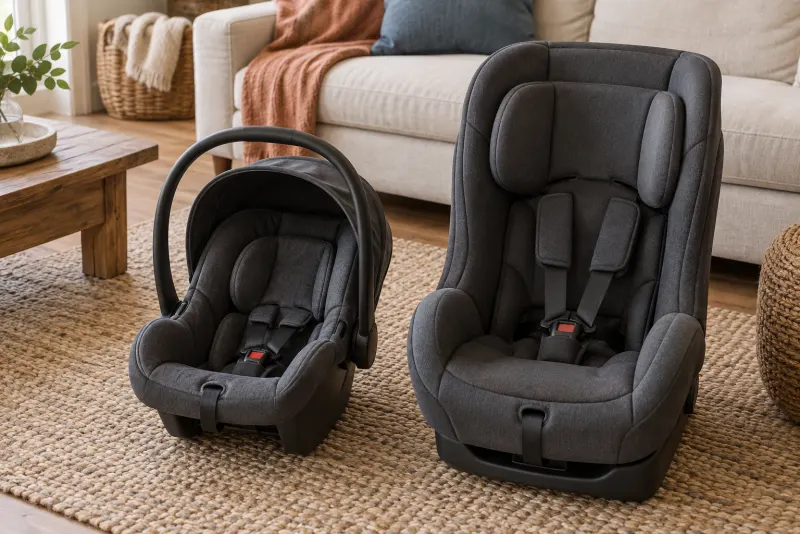
Maxi-Cosi and Nuna car seats meet the same federal crash standard, FMVSS 213 [1], so neither brand is safer by name. The real differences are weight, rotation, rear-facing limits and lifespan. Nuna's infant carriers are lighter. Maxi-Cosi's Peri 180 base rotates. Nuna's convertibles rear-face to 50 pounds, 10 more than Maxi-Cosi's.
We don't test car seats. Everything here comes from the makers' pages and manuals and NHTSA's recall data, read on October 16, 2026. Your seat's label and manual are the final word.
Maxi-Cosi vs Nuna at a glance
| Maxi-Cosi | Nuna | |
|---|---|---|
| Infant seats | Peri 180, Mico Pro, Mico Pro+ [3][5] | PIPA aire rx, PIPA rx [10][11] |
| Infant limits | 4 to 30 lb, up to 32 in [3][5] | 4 to 30 lb, 16 to 30 in [10][11] |
| Lightest carrier listed | Peri 180: under 8 lb without canopy and inserts [3] | PIPA aire rx: 6.2 lb [11] |
| Infant lifespan | 8 years [4] | Read the label; manuals print no number [12] |
| Convertible / all-in-one | Pria, Romi [6][7] | RAVA next, EXEC next [15][16] |
| Rear-facing limit | 40 lb, 40 in [6][7] | 50 lb, 49 in with the seat belt [15][16] |
| Convertible lifespan | 10 years [8] | 10 years [17][18] |
| NHTSA recall campaigns found | 6 since 2010 [21][22][23][24][25][26] | 1 (RAVA, 2024) [19] |
Infant seats: Peri 180 and Mico vs PIPA
Both brands stop at 30 pounds. Maxi-Cosi lists up to 32 inches for the Peri 180 and Mico Pro. Nuna lists 16 to 30 inches for the PIPA aire rx and PIPA rx [3][5][10][11]. Most babies hit the height limit before the weight limit, so Maxi-Cosi's 2 extra inches can mean a few more months in the carrier. Both makers also require the baby's head to sit at least 1 inch below the top of the shell [4][12].
Here are the two Nuna seats with the specs Nuna publishes:
| Model | Child weight | Child height | Carrier weight | Installs | Rebound or load leg |
|---|---|---|---|---|---|
| Nuna PIPA rxRear-facing infant seat with RELX base and stability leg | 4 to 30 lb | 16 to 30 in | 7.6 lb without canopy and inserts (about 1 lb more with them) | RELX base with LATCH or seat belt; seat belt without base | Steel stability leg on the base; anti-rebound panel |
| Nuna PIPA aire rxRear-facing infant seat with stability leg | 4 to 30 lb | 16 to 30 in | 6.2 lb without canopy and inserts (about 2.2 lb more with them) | Base with rigid LATCH or seat belt; seat belt without base | Steel stability leg on the base; anti-rebound panel |
Carrier weight
Nuna lists the PIPA aire rx at 6.2 pounds and the PIPA rx at 7.6, both without canopy and inserts [10][11]. Maxi-Cosi says the Peri 180 weighs under 8 pounds without its canopy and inserts, which weigh about 1 pound together [3]. The gap is real if you carry the seat a lot, but it's roughly a pound and a half at the high end.
Bases and rotation
The Peri 180 is the only seat here with a rotating base. Maxi-Cosi's Peri 180 base turns 180 degrees for loading, has an anti-rotation load leg, and fits the Peri 180 only [3][9]. The seat comes with one base [3].
Nuna's PIPA bases don't rotate. They're steel-reinforced, with a stability leg and rigid lower attachments. Nuna says both the PIPA series base and the RELX base fit every PIPA series seat, and neither fits the PIPA urbn [13][14]. If you want a second base for another car, either works.
Installing without a base
Nuna's PIPA rx manual describes a carrier-only install "in 2 different ways" without a base, which suits taxis and rideshares [12]. Maxi-Cosi's Mico Pro page describes belt guides for installing without the base, which it calls taxi mode. On the Peri 180, both Maxi-Cosi's guides say that on an airplane the seat can only be installed without the base [3][4][5].
Convertibles: Pria and Romi vs RAVA next and EXEC next
| Seat | Rear-facing | Forward-facing (harness) | Booster | Seat weight | Expires after |
|---|---|---|---|---|---|
| Maxi-Cosi Pria [6] | 5 to 40 lb, 19 to 40 in | 30 to 65 lb, 34.4 to 49 in | 40 to 100 lb, 43.4 to 52 in | Not on page | 10 years [8] |
| Maxi-Cosi Romi [7] | 5 to 40 lb, 19 to 40 in | 30 to 50 lb, 34.4 to 44 in | n/a | Not on page | 10 years |
| Nuna RAVA next [15] | 5 to 50 lb, 18 to 49 in | 30 to 65 lb, 34 to 49 in | n/a | 26.5 lb | 10 years [17] |
| Nuna EXEC next [16] | 5 to 50 lb, 18 to 49 in | 30 to 65 lb, 34 to 49 in | 40 to 110 lb, 43 to 57 in | 26.8 lb | 10 years [18] |
Nuna's rear-facing numbers are for a seat belt install. With the lower anchors, Nuna lists 5 to 35 pounds rear-facing and 30 to 40 pounds forward-facing [15][16]. Past the anchor limit, reinstall with the belt.
The AAP says to keep a child rear-facing until they reach the top height or weight limit of their seat [2]. On paper, the RAVA next and EXEC next give you 10 more rear-facing pounds and 9 more inches than the Pria and Romi. The Pria goes further as a booster than a Romi, and the EXEC next goes to 110 pounds.
Here's the Pria as Maxi-Cosi publishes it:
| Model | Rear-facing | Forward-facing | Booster | Seat weight | Width | Expiration | Where to buy |
|---|---|---|---|---|---|---|---|
| Maxi-Cosi Pria All-in-OneAll-in-one (3 modes) | 5–40 lb, 19–40 in | 30–65 lb, 34.4–49 in | Belt-positioning 40–100 lb, 43.4–52 in | Not on product page | Not on product page | 10 years from date of manufacture (user guide) | Check on AmazonAffiliate link |
For how infant seats and convertibles differ, see our infant vs convertible comparison.
How long each brand's seats last
Maxi-Cosi's infant seats (Mico Pro, Mico Pro+, Mico 30, Peri 180) are 8 years from the date of manufacture. The Pria and Romi are 10 [4][8][29]. Nuna's RAVA next and EXEC next manuals say not to use a seat more than 10 years old [17][18]. The PIPA manuals we read don't print a number; they say to check the expiration label under the carrier or base [12]. The base has its own date.
Our car seat expiration guide compares 11 brands side by side.
Recalls we found
We searched NHTSA's child restraint recall data for both brands on October 16, 2026. Recalls can be added at any time, so look up your seat's model number and date at NHTSA's recall search [27].
Maxi-Cosi has six campaigns since 2010:
- 23C-003 (2023): Coral XP inner carrier [22].
- 23C-002 (2023): lower anchors on Mico XP, Mico XP Max, Mico Luxe+, Coral XP and the Maxi-Cosi Infant Base [21].
- 21C-004 and 21C-003 (2021): Pria 70 and Pria 85 forward-facing label and tether issue [23][24].
- 11C-001 (2011): harness adjuster button on Mico and other Dorel seats [25].
- 10C-001 (2010): Mico infant seats built in 2008 [26].
None of those names a current Peri 180, Mico Pro, Pria or Romi. Our Maxi-Cosi car seat guide has the fix for each, and the full list is on our Maxi-Cosi recalls page.
Nuna has one: 24C-002, a 2024 recall of the RAVA, made July 16, 2016 to October 25, 2023. Debris can get into the plastic harness adjuster button and make it fail, loosening the harness. NHTSA lists 608,786 seats. The fix is a free remedy kit from Nuna [19][20]. No PIPA campaign turned up, and SafetyBeltSafe's January 2026 list says no recalls, replacement parts or warnings for the PIPA, PIPA aire rx, PIPA rx and PIPA urbn [28]. See our Nuna car seat guide for the model numbers.
Who each brand fits
- Maxi-Cosi Peri 180: A parent who lifts a baby in and out of a back seat often, and wants a rotating base and a 32-inch height limit.
- Nuna PIPA aire rx: A parent who carries the seat a lot or rides in taxis, and wants the lightest carrier of the group.
- Maxi-Cosi Pria: A parent who wants a single seat from birth to a 100-pound booster.
- Nuna RAVA next or EXEC next: A parent who wants the longest rear-facing runway, 50 pounds, with the seat belt.
Check current listings: Pria on Amazon Affiliate link, and for the Peri 180 base, Check price on Amazon Affiliate link. Nuna sells the PIPA and RAVA through its own site and other stores.
Not sure whether a seat fits your car or budget? Our infant car seat guide puts more brands side by side, and our state car seat laws page covers when your child must move up. For brand details, see the Maxi-Cosi and Nuna hubs.
Questions people ask
Is Maxi-Cosi or Nuna safer?
Neither. Every infant and convertible seat sold in the US has to meet the same federal standard, FMVSS 213. The AAP says the right seat is the one that fits your child and your vehicle, is installed correctly and is used on every ride. The differences between these two brands are features, weight and fit.
Which is lighter, a Maxi-Cosi or a Nuna infant seat?
Nuna, by the makers' published numbers. Nuna lists the PIPA aire rx carrier at 6.2 pounds and the PIPA rx at 7.6, without canopy and inserts. Maxi-Cosi says the Peri 180 weighs under 8 pounds without its canopy and inserts, which together add about 1 pound.
How long is a Maxi-Cosi car seat good for?
Maxi-Cosi's infant seats (Mico Pro, Mico Pro+, Mico 30 and Peri 180) are 8 years from the date of manufacture. The Pria and Romi are 10. The date is on a label on the seat, and the lifespan is in the user guide.
How long is a Nuna car seat good for?
The RAVA next and EXEC next manuals say not to use the seat if it is more than 10 years old. The PIPA manuals we read don't print a number and say to check the expiration label on the underside of the carrier or base, so follow the label.
Can a Maxi-Cosi seat go on a Nuna base?
No. Seats fit the bases their maker lists. Maxi-Cosi's Peri 180 base lists the Peri 180 only, and Nuna's PIPA bases list PIPA series seats. Never mix a carrier and a base from different brands.
Which rear-faces longer, Maxi-Cosi or Nuna?
Nuna's RAVA next and EXEC next rear-face to 50 pounds and 49 inches with the vehicle seat belt. Maxi-Cosi's Pria and Romi rear-face to 40 pounds and 40 inches. The AAP says to keep a child rear-facing until they reach the top height or weight limit of their seat.
Sources
Numbers in brackets in the guide link to these sources.
- 1.49 CFR 571.213, Standard No. 213: Child restraint systemsElectronic Code of Federal Regulations (NHTSA), 2026
- 2.Car Seats: Information for FamiliesAmerican Academy of Pediatrics (HealthyChildren.org), 2026
- 3.Peri 180 Rotating Infant Car Seat (product page)Maxi-Cosi, 2026
- 4.Peri 180 Rotating Infant Car Seat User GuideMaxi-Cosi (Dorel Juvenile Group), 2026
- 5.Mico Pro Infant Car Seat (product page)Maxi-Cosi, 2026
- 6.Pria All-in-One Convertible Car Seat (product page)Maxi-Cosi, 2026
- 7.Romi 2-in-1 Convertible Car Seat (product page)Maxi-Cosi, 2026
- 8.Pria All-in-One Convertible Car Seat User GuideMaxi-Cosi (Dorel Juvenile Group), 2026
- 9.Peri 180 Rotating Infant Car Seat Base (product page, IC402)Maxi-Cosi, 2026
- 10.PIPA rx Infant Car Seat with RELX Base (product page)Nuna, 2026
- 11.PIPA aire rx + PIPA RELX base (product page)Nuna, 2026
- 12.PIPA rx Infant Car Seat User Manual (US)Nuna, 2026
- 13.PIPA series base (product page)Nuna, 2026
- 14.PIPA RELX base (product page)Nuna, 2026
- 15.RAVA next Convertible Car Seat (product page)Nuna, 2026
- 16.EXEC next All-in-One Car Seat (product page)Nuna, 2026
- 17.RAVA next Convertible Car Seat User Manual (US)Nuna, 2026
- 18.EXEC next All-in-One Car Seat User Manual (US)Nuna, 2026
- 19.Recall 24C-002: Nuna RAVA harness adjuster buttonNational Highway Traffic Safety Administration (NHTSA), 2024
- 20.Voluntary recall: Nuna RAVA manufactured between July 16, 2016 and October 25, 2023Nuna, 2024
- 21.Recall 23C-002: Safety 1st and Maxi-Cosi infant seats and bases, lower anchorsNational Highway Traffic Safety Administration (NHTSA), 2023
- 22.Recall 23C-003: Maxi-Cosi Coral XP infant seat, inner carrierNational Highway Traffic Safety Administration (NHTSA), 2023
- 23.Recall 21C-004: Maxi-Cosi Pria 70 convertible seatsNational Highway Traffic Safety Administration (NHTSA), 2021
- 24.Recall 21C-003: Maxi-Cosi Pria 85 convertible seatsNational Highway Traffic Safety Administration (NHTSA), 2021
- 25.Recall 11C-001: Dorel Juvenile Group infant, convertible and booster seats, harness adjuster buttonNational Highway Traffic Safety Administration (NHTSA), 2011
- 26.Recall 10C-001: Maxi-Cosi Mico infant seats and base, mounting bracketNational Highway Traffic Safety Administration (NHTSA), 2010
- 27.Recalls: search by vehicle, car seat or equipmentNational Highway Traffic Safety Administration (NHTSA), 2026
- 28.List of Recalls and Replacement Parts for Child Restraints (January 25, 2026)SafetyBeltSafe U.S.A., 2026
- 29.Romi Convertible Car Seat User GuideMaxi-Cosi (Dorel Juvenile Group), 2026