The Mom Site · themomsite.com/gear/spectra-s1-vs-s2/
On this page15 sections
- Key takeaways
- What is the difference between the Spectra S1 and S2?
- Spectra S1 Plus vs S2 Plus specs side by side
- Is the Spectra S1 stronger than the S2?
- Why does the Spectra S1 cost extra through insurance?
- Can I pay the upgrade fee with an HSA or FSA?
- What does insurance cover for a breast pump?
- How to get a Spectra pump through insurance
- Which Spectra fits your situation?
- What flange sizes come with the Spectra S1 and S2?
- Does insurance cover Spectra replacement parts?
- Spectra vs Medela: how do they compare?
- Questions to ask before you order
- Questions people ask
- Sources
Key takeaways
- Spectra lists the same 270 mmHg maximum suction, 12 suction levels, massage and expression modes, LCD timer, night light and closed system for both the S1 Plus and S2 Plus.
- The real difference is power: the S1 Plus has a built-in rechargeable battery, and the S2 Plus is plug-in only.
- The supplier Byram says that because of portability, the S1 often requires an upgrade fee, while the S2 is commonly fully covered.
- An upgrade fee is the difference between what your plan covers and the pump's price. Byram says it isn't reimbursable by insurance but may be paid with HSA or FSA money.
- Both pumps come with two 24 mm and two 28 mm flanges. Spectra sells other sizes from 16 mm to 32 mm and says to add 2 to 3 mm to your nipple measurement.
At a glance
Spectra S1 Plus
Suits: Parents who expect to pump away from an outlet: in the car, moving between rooms, or at a job without a convenient plug.
- Strength: Built-in rechargeable battery, so no cord while pumping
- Strength: Same 270 mmHg maximum, modes and closed system as the S2 Plus
- Strength: Comes with 24 mm and 28 mm flanges
- Trade-off: Often an upgrade fee through insurance suppliers
- Trade-off: Spectra lists it at 3 lb, so it's not light
- Trade-off: Spectra's product page doesn't state battery run time
Spectra S2 Plus
Suits: Parents who will mostly pump at home or at a desk near an outlet and want a pump that's commonly covered at no cost.
- Strength: Commonly fully covered through insurance, per Byram
- Strength: Same 270 mmHg maximum, modes and closed system as the S1 Plus
- Strength: Comes with 24 mm and 28 mm flanges
- Trade-off: Plug-in only, so you need an outlet every session
- Trade-off: Spectra lists its weight as both 2.5 lb and 3 lb
- Trade-off: Not built for pumping on the move
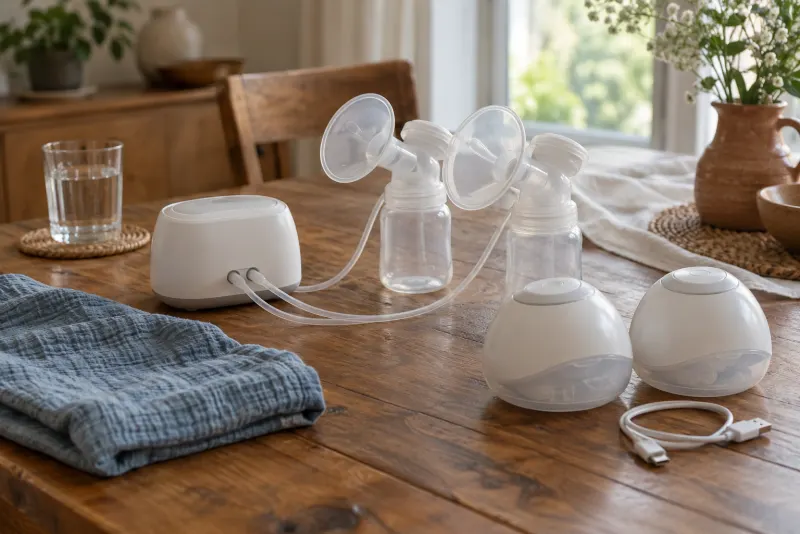
The Spectra S1 Plus and S2 Plus are the same pump on paper, with one difference: the S1 Plus has a built-in rechargeable battery and the S2 Plus has to be plugged in. Spectra lists the same 270 mmHg maximum suction, the same massage and expression modes, the same timer, night light and closed system, and the same included flanges for both [1][2]. That battery is also why the S1 often costs an upgrade fee through insurance, while the S2 is commonly covered in full [3].
Below, we line the two up using only what Spectra publishes on its own product pages, explain how insurance tiers work for each, and cover the flange sizes that come in the box. We research products; we don't test them, and we don't rank them.
What is the difference between the Spectra S1 and S2?
The difference is the power source. The S1 Plus is described as "portable with built-in battery," while the S2 Plus product page lists only a 12V AC power adapter, and Byram describes it as "plug-in only" [1][2][3].
Almost everything else Spectra lists is shared. Both product pages describe:
- Up to 270 mmHg of suction, which Spectra calls "hospital strength," with adjustable levels up to L12 [1][2].
- Massage mode with 5 levels, and a separate expression mode [1][2].
- A closed system that Spectra says "prevents backflow into tubing or pump" [1][2].
- An LCD screen with an auto-off timer that shuts the pump off after 30 minutes [1][2].
- A built-in night light for late-night sessions [1][2].
- Single or double pumping [1][2].
- The same warranty terms: a 2-year limited pump warranty and a 90-day limited parts warranty [1][2].
So if you're choosing between them, you're really choosing whether you'll pump away from an outlet often enough to want a battery, and whether that's worth any upgrade fee your supplier charges.
Spectra S1 Plus vs S2 Plus specs side by side
On Spectra's published specs, the two pumps match on suction, modes and features, and differ on power and, slightly, on listed weight [1][2].
| Spec | Spectra S1 Plus | Spectra S2 Plus |
|---|---|---|
| Maximum suction | 270 mmHg [1] | 270 mmHg [2] |
| Suction levels | Up to L12 [1] | Up to L12 [2] |
| Modes | Massage (5 levels) and expression [1] | Massage (5 levels) and expression [2] |
| Power | Built-in rechargeable battery, plus 12V AC adapter/charger [1] | 12V AC adapter; plug-in only [2][3] |
| Battery run time | Not stated on Spectra's product page [1] | No battery |
| Weight | 3 lb [1] | Listed as both 2.5 lb and 3 lb on the same page [2] |
| Closed system | Yes [1] | Yes, "a true closed system" [2] |
| Timer and display | LCD, 30-minute auto-off [1] | LCD, 30-minute auto-off [2] |
| Night light | Yes [1] | Yes [2] |
| Flanges in the box | Two 24 mm, two 28 mm [1] | Two 24 mm, two 28 mm [2] |
| Warranty | 2-year pump, 90-day parts [1] | 2-year pump, 90-day parts [2] |
| Typical insurance tier | Often an upgrade fee, per Byram [3] | Commonly fully covered, per Byram [3] |
Here is the same comparison drawn from our product registry, with every value linked to the maker's page:
| Model | Max suction | Weight | Power | Closed system | Coverage / where to buy |
|---|---|---|---|---|---|
| Spectra S1 PlusTraditional double electric | 270 mmHg | 3 lb | Built-in rechargeable battery | Yes | Often an upgrade fee, per ByramAmazonAffiliate link |
| Spectra S2 PlusTraditional double electric | 270 mmHg | 2.5 to 3 lb | Plug-in only | Yes | Commonly fully covered, per ByramAmazonAffiliate link |
Two notes on the table. First, Spectra's S2 Plus page gives its weight in two places, as "3lbs" and as "2.5 pounds," so we show both rather than pick one [2]. Second, Spectra's S1 Plus page doesn't give a battery run time [1]. Other websites quote figures, but we couldn't confirm one on Spectra's own page, so check the manual in the box or ask Spectra.
Is the Spectra S1 stronger than the S2?
No. Spectra lists the same 270 mmHg maximum and the same top suction level, L12, for both pumps [1][2]. The battery changes where you can pump, not how strongly the pump pulls.
It also helps to know that maximum suction is a ceiling, not a target. The Academy of Breastfeeding Medicine notes that pumps can injure breast tissue and the nipple when flanges don't fit, suction is set too high, or sessions run too long [10]. Most people find a comfortable setting well below the top. If pumping hurts, talk to your provider or a lactation consultant rather than turning the pump up.
You'll also see "hospital strength" on both product pages [1][2]. The FDA says the related term "hospital-grade pump" isn't recognized by the agency and has no consistent definition, so companies can mean different things by it [6]. Treat it as marketing wording, not a regulated category.
Why does the Spectra S1 cost extra through insurance?
Because of the battery. Byram, an insurance breast pump supplier, puts it plainly: "Because of portability, the S1 often requires an upgrade fee, while the S2 is commonly fully covered" [3].
Here's how the tiers work. Byram explains that most plans cover pumps up to a certain value as "fully covered," and that "the upgrade fee is the difference between the covered amount and the price of the pump" [3]. A pump priced at or below what your plan pays costs you nothing. A pump priced above it costs you the difference.
Byram's 2026 lists show where the two Spectra models usually land [3]:
- Most common fully covered pumps: Spectra S2, Lansinoh DiscreetDuo Flow, Zomee Fit, BabyBuddha 2.0 and Ardo Melia.
- Most common upgrade pumps: Spectra S1, Elvie Stride, Willow Go, Zomee W1 and Willow Sync.
Byram doesn't publish its upgrade fees in dollars on that page, and the fee for the same pump can differ from one plan to the next [3]. That's why we don't list one here. Ask your supplier for the exact amount for your plan, in writing, before you order.
Can I pay the upgrade fee with an HSA or FSA?
Usually, yes. Byram says upgrade fees "are not reimbursable by insurance," but they may be eligible for FSA or HSA funds [3]. The IRS says you can include "the cost of breast pumps and supplies that assist lactation" in medical expenses [7].
A few practical points:
- Check with your plan administrator before you pay, as Byram suggests [3]. Some FSA administrators ask for an itemized receipt.
- A health care FSA is different from a dependent care FSA. A dependent care FSA pays for child care, not medical supplies. Our guide to the dependent care FSA explains that account.
- Keep the receipt that shows the upgrade fee separately from what insurance paid.
What does insurance cover for a breast pump?
Most plans must cover a breast pump, but each plan sets the details. HealthCare.gov says "your health insurance plan must cover the cost of a breast pump," and that it "may be either a rental unit or a new one you'll keep" [4]. Plans can also decide whether it's manual or electric and whether you get it before or after birth [4].
The requirement applies to Marketplace plans and most other health plans, but not to grandfathered plans [4]. If your employer's plan has been around a long time without major changes, ask whether it's grandfathered.
Insurer policies add their own rules. Aetna's clinical policy, for example, covers the purchase of a manual or standard electric pump for plans subject to the federal requirement, and a replacement pump for each later pregnancy [5]. It covers hospital-grade pump rental during a newborn's hospital stay, and it does not consider the purchase of a wearable, battery-operated pump medically necessary [5]. The S1 Plus isn't a wearable, but this is a good example of how insurers draw lines by pump type, so read your own plan's rules.
For insurer-by-insurer details, see our guides for Aetna, Cigna, UnitedHealthcare, Blue Cross Blue Shield, Kaiser Permanente and Tricare. If you're on Medicaid, coverage depends on your state: see Medicaid breast pump coverage by state.
How to get a Spectra pump through insurance
With most plans, you order through an in-network durable medical equipment (DME) supplier rather than a store. The supplier checks your plan, shows you which pumps are $0 and which carry a fee, and ships the pump. Our step-by-step guide to getting a breast pump through insurance covers the process in detail.
The short version:
- Find your plan's suppliers. Call the number on your insurance card or check your insurer's website for in-network breast pump suppliers.
- Give the supplier your details. They usually need your insurance information, your due date and your provider's name. Some plans need a prescription, and many suppliers request it for you.
- Compare the S1 and S2 on your plan. Ask whether the S2 Plus is $0 and what the S1 Plus upgrade fee would be.
- Order early. Byram suggests starting around week 30 of pregnancy and says it holds the order until your plan allows shipping, which is often within 30 days of your due date or after birth [3].
- Ask about replacement parts. Byram says many plans cover monthly replacement parts, including tubing and valves, at no extra cost [3].
If you'd rather start online, you can check what your plan covers and order a pump Partner through a supplier that works with many insurers. Compare the S1 and S2 tiers there the same way.
A word on used pumps. The FDA considers most breast pumps single-user devices, because there's no way to guarantee one can be cleaned and disinfected between different users [6]. It also notes that buying a used pump may violate the manufacturer's warranty [6]. Getting a new pump through insurance avoids both problems.
Which Spectra fits your situation?
Neither pump is right for everyone. Since the specs match, the choice comes down to where you'll pump and what your plan charges.
| Your situation | What points toward the S1 Plus | What points toward the S2 Plus |
|---|---|---|
| Pumping mostly at home | Rarely needed | Plug-in works fine, and it's commonly $0 [3] |
| Pumping at a desk with an outlet | Optional | Plug-in works fine [3] |
| Pumping in the car or while commuting | A built-in battery avoids the cord [1] | You'd need an outlet [3] |
| Moving between rooms with a newborn | Easier to carry while running [1] | Moves with you only as far as the cord |
| Your plan covers the S2 at $0 and charges a fee for the S1 | Worth it if you'll use the battery often | Keeps your cost at $0 |
| Your plan covers both at $0 | Battery flexibility at no extra cost | Same specs, no battery to maintain |
A few questions can help you decide:
- Where will most sessions happen? If the answer is a nursery chair or an office with an outlet, the battery adds little. If it's a car, a shared workspace or a home without a convenient outlet, it can matter more.
- Will you pump often? If you're planning to pump at work or follow a frequent pumping schedule, think through where each session will happen.
- What does your plan actually charge? The fee, if any, is plan-specific [3]. Get the number before you decide.
What flange sizes come with the Spectra S1 and S2?
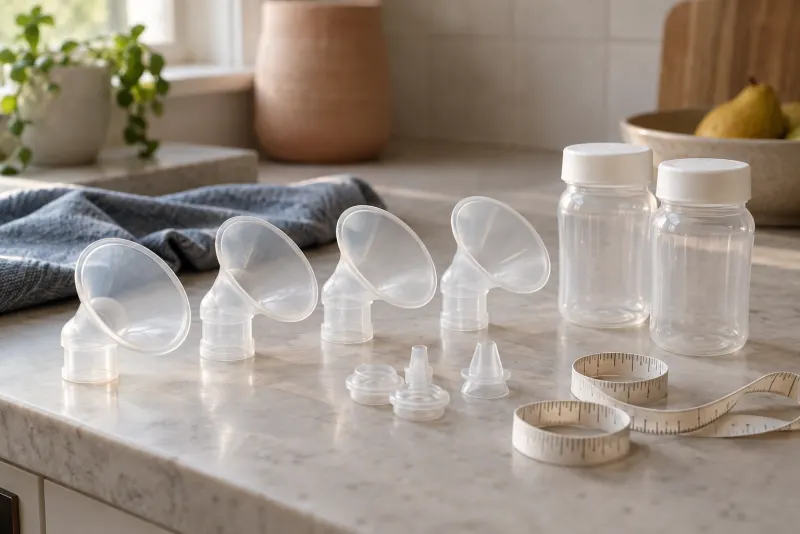
Both pumps come with two 24 mm and two 28 mm flanges [1][2]. Spectra sells additional sizes of 16, 20, 24, 28 and 32 mm [9].
To choose a size, Spectra's guide says to measure across your nipple, then "add 2-3mm to find your flange size" [8]. It gives the example of a 16 mm measurement fitting a 19 to 20 mm flange [8]. Spectra also says not to measure your nipples while pregnant, to measure both sides since they can differ, and that your size may change once your milk supply is established, around 10 weeks postpartum [8].
That means the sizes in the box may not fit you. If your measurement points to a different size, ask your supplier whether it can send other sizes, or buy them separately. A poor fit can make pumping painful and less effective, and the Academy of Breastfeeding Medicine lists improper flange size among the causes of pumping-related injury [10].
Our breast pump flange size guide walks through measuring step by step and compares sizing charts across brands. If you're unsure, a lactation consultant can check your fit in person. See whether insurance covers lactation consultants.
Does insurance cover Spectra replacement parts?
Often, yes, within limits your plan sets. Byram says many plans cover monthly replacement parts, including tubing and valves, at no additional cost [3]. Both Spectra pumps use the same kinds of parts in the box: tubing, duckbill valves, backflow protectors, flanges and bottles [1][2].
Limits vary by insurer. Aetna's policy, for example, caps replacement tubing, adapters, shields and locking rings at 8 per year, allows up to 8 replacement bottles and 8 replacement caps or lids a year, and covers up to 4 boxes of 100 milk storage bags a month [5]. Other insurers set their own numbers, so ask your supplier what yours allows and how to reorder.
Spectra vs Medela: how do they compare?
Comparing the Spectra S2 Plus with Medela's Pump In Style Pro, two traditional double electric pumps, on what each maker publishes:
| Spec | Spectra S2 Plus | Medela Pump In Style Pro |
|---|---|---|
| Maximum suction | 270 mmHg [2] | Not stated on the product page [11] |
| Suction levels | Up to L12 [2] | 16 vacuum levels in each phase [11] |
| Weight | 2.5 or 3 lb (Spectra lists both) [2] | 1.23 lb [11] |
| Power | 12V AC adapter [2] | AC power adapter [11] |
| Backflow protection | "A true closed system" [2] | "Milk barrier" at the breast shield [11] |
| Sizes in the box | 24 mm and 28 mm [2] | 21 mm and 24 mm [11] |
The Medela pump is lighter on paper, and it starts with a smaller included size [2][11]. Spectra publishes a maximum suction figure and Medela's product page doesn't [2][11]. Both makers describe a barrier to keep milk out of the tubing, in different words [2][11].
For more models side by side, including wearables, see breast pumps covered by insurance.
For other pumps sorted by how you'll use them, see breast pumps compared.
For all four pumps side by side, see Spectra vs Medela compared.
Questions to ask before you order
Before you settle on the S1 or S2, ask your supplier:
- Is the Spectra S2 Plus $0 on my plan?
- What's the exact upgrade fee for the Spectra S1 Plus, and can I get it in writing?
- Is my plan grandfathered, or does it follow the federal breast pump rule?
- Which flange sizes can you send besides the 24 mm and 28 mm in the box?
- How often will my plan cover replacement parts and milk storage bags?
- When will the pump ship: before birth, or after?
And ask your own provider or a lactation consultant about anything medical, such as pain while pumping, low supply or pumping for a baby in the NICU. They know your situation, and a pump choice is only one part of feeding plans that work.
Questions people ask
What is the difference between the Spectra S1 and S2?
The S1 Plus has a built-in rechargeable battery and the S2 Plus is plug-in only. On Spectra's pages, both reach 270 mmHg and share the same massage and expression modes, timer, night light, closed system and included 24 mm and 28 mm flanges.
Is the Spectra S1 covered by insurance?
Often, but usually with an upgrade fee. The supplier Byram says the S1 often requires an upgrade fee because of its portability, while the S2 is commonly fully covered. Byram lists the S2 first among its most common fully covered pumps for 2026, but your plan and supplier decide the final cost, so ask before you order.
How long does the Spectra S1 battery last?
Spectra's S1 Plus product page says it is portable with a built-in battery but doesn't state a run time. Check the manual that comes with the pump or ask Spectra directly for its figure.
Can I pay the Spectra S1 upgrade fee with my HSA or FSA?
Usually. The IRS counts breast pumps and lactation supplies as medical expenses, and Byram says upgrade fees may be eligible for FSA or HSA money. Confirm with your plan administrator.
What flange size comes with the Spectra S1 and S2?
Both come with two 24 mm and two 28 mm flanges. Spectra sells 16, 20, 24, 28 and 32 mm sizes and says to measure your nipple after birth and add 2 to 3 mm.
Spectra vs Medela: what's the difference?
On published specs, the Spectra S2 Plus lists 270 mmHg maximum suction and a closed system, while Medela's Pump In Style Pro weighs 1.23 lb, uses a milk barrier at the breast shield, and doesn't list maximum suction on its product page.
Sources
Numbers in brackets in the guide link to these sources.
- 1.Spectra S1 Plus Premier Rechargeable Double Electric Breast PumpSpectra Baby USA, 2026
- 2.Spectra S2 Plus Premier Double Electric Breast PumpSpectra Baby USA, 2026
- 3.Breast Pumps Through Insurance (FAQ)Byram Healthcare (Byram Baby), 2026
- 4.Breastfeeding benefitsHealthCare.gov (U.S. Centers for Medicare & Medicaid Services), 2026
- 5.Breast Pumps, Clinical Policy Bulletin 0421Aetna, 2026
- 6.Buying and Renting a Breast PumpU.S. Food and Drug Administration (FDA), 2026
- 7.Publication 502: Medical and Dental ExpensesInternal Revenue Service (IRS), 2026
- 8.Flange Size Guide: How to Find Your Breast Pump Flange SizeSpectra Baby USA, 2026
- 9.Spectra Wide Breast Flange SetSpectra Baby USA, 2026
- 10.ABM Clinical Protocol #36: The Mastitis Spectrum, Revised 2022Academy of Breastfeeding Medicine, Breastfeeding Medicine, 2022
- 11.Pump In Style Pro Double Electric Breast PumpMedela, 2026