The Mom Site · themomsite.com/gear/breast-pump-flange-size/
On this page12 sections
- Key takeaways
- What a breast pump flange is
- How to measure your nipple for a flange
- How makers turn your measurement into a size
- Flange sizes each maker sells
- Signs your flange doesn't fit
- Inserts and wearable pump cups
- Why your flange size can change
- When to get help with flange fit
- Extra flanges and replacement parts
- Questions people ask
- Sources
Key takeaways
- Measure across your nipple, not the areola, in millimeters before you pump. Medela says nipples expand by an average of 2 to 3 mm in diameter during pumping.
- Makers' rules differ: Medela adds 4 mm to your measurement, Spectra adds 2 to 3 mm, Cleveland Clinic suggests 2 to 4 mm, and Lansinoh matches its chart to the nipple tip.
- A flange fits when your nipple moves freely without rubbing, little areola is pulled in and pumping doesn't hurt. Pain, rubbing, swelling or low output are reasons to re-check.
- Your size can change after birth and over months of pumping. Spectra flags about 10 weeks postpartum, and Willow suggests re-sizing every three months.
- A lactation consultant can check your fit, and most health plans must cover lactation support and counseling. Ask your plan how many replacement flanges it allows.
Your flange size is the width of the tunnel your nipple sits in, measured in millimeters. To find a starting size, measure across your nipple (not the areola) before you pump, then apply your pump maker's rule: Cleveland Clinic's breastfeeding specialist suggests adding 2 to 4 mm, Medela adds 4 mm and Spectra adds 2 to 3 mm [1][2][3]. The right size is the one where your nipple moves freely, little areola gets pulled in and pumping doesn't hurt, and it can change after birth [1][2].
We don't test pumps or flanges. This guide lines up the sizing charts makers publish with guidance from health systems and lactation sources.
What a breast pump flange is
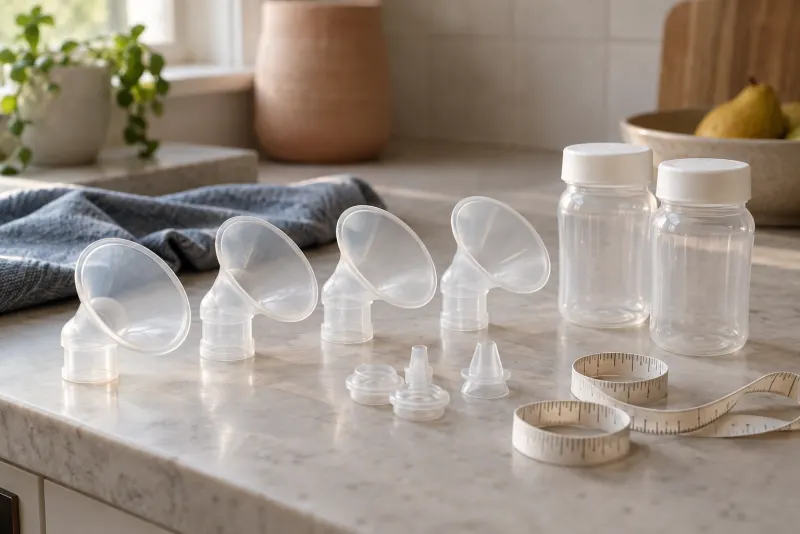
The flange, which Medela and Elvie call a breast shield, is the cone-shaped piece that rests on your breast and areola. Its size is the width of the tunnel your nipple goes into [1]. Cleveland Clinic says sizes run from about 13 mm to over 30 mm, and many pumps come with a standard "medium" of about 24 mm, which doesn't fit everyone [1].
Fit matters for more than comfort. The Academy of Breastfeeding Medicine notes that pumps can injure breast tissue, the nipple and the areola when flange sizes are wrong, suction is too high or sessions run too long [4]. So treat the size in the box as a starting point.
How to measure your nipple for a flange
Cleveland Clinic and the makers agree on most of the steps:
- Wait until after birth if you can. Cleveland Clinic suggests waiting because hormones can change nipple size, though measuring in pregnancy gives a rough estimate [1]. Spectra says not to measure while pregnant [3], and Medela says breasts and nipples can change between the third trimester and after childbirth [2].
- Measure before you pump or nurse. Medela says nipples expand by an average of 2 to 3 mm in diameter from before to after pumping [2]. Elvie says not to measure right after pumping or breastfeeding [5].
- Gently roll the nipple first for a few seconds to stimulate it, while it's in a neutral state before pumping or nursing [1].
- Measure the nipple only, in millimeters. Cleveland Clinic and Medela say to measure across the widest part, usually the base, and to leave the areola out [1][2]. Elvie defines the base as where the nipple meets the areola [5].
- Measure both sides. Your left and right nipples may need different sizes [1][2][5].
A ruler with millimeter markings works. Spectra has a printable sizing sheet (print it at 100% scale) and says a coin can help if you don't have a printer [3].
One catch on where to measure: Lansinoh's chart says to measure the tip of the nipple [6], and so does the Flange FITS Guide that Washington State's WIC program distributes [7]. Check which point your pump maker means before you compare numbers.
How makers turn your measurement into a size
There's no single formula. Cleveland Clinic's specialist calls adding 2 to 4 mm a starting point, not an evidence-based rule [1], and Medela calls its own method "a flexible guideline rather than a strict rule" [2]. Here's what each source says:
| Source | Where to measure | Rule for a starting size |
|---|---|---|
| Cleveland Clinic | Widest point, usually the base | Add 2 to 4 mm. An 18 mm nipple may fit a 20 or 21 mm flange [1] |
| Medela | Base | Add 4 mm and pick the closest size. A 15 mm nipple plus 4 is 19, so start at 18 mm [2] |
| Spectra | Nipple, before pumping | Add 2 to 3 mm to your measurement [3] |
| Elvie (Elvie Pump, Stride) | Base | Its chart: 18 to 19 mm uses 21 mm, 20 to 22 mm uses 24 mm, 23 to 26 mm uses 28 mm [5] |
| Lansinoh | Tip | Pick the flange or insert closest to your measurement [6] |
| Willow | Measure for Willow | Says its sizing "may be different than other pumps you've used" [8] |
Why the gap between "add 4 mm" and "match the tip"? The guidance is shifting. In a pilot study published in the Journal of Human Lactation in 2025, 36 parents feeding their babies only their own milk pumped with two flange sizes for a week each. Flanges chosen close to the nipple tip measurement were rated more comfortable, and produced a little more milk per session on average, than sizes picked from pump makers' instructions [9]. The authors say guidance from providers and pump makers is inconsistent. They also call the work a pilot, disclose that one author created the sizing guide they tested, and caution against blanket advice to size down [9].
In practice: use your own pump maker's chart to pick a first size, then judge the fit while you pump.
Flange sizes each maker sells
These are the sizes each maker lists on its own pages as of October 2026. "In the box" is one example model, so check the contents of the pump you get.
| Maker and line | Flange sizes | Inserts | In the box |
|---|---|---|---|
| Medela PersonalFit Plus and Flex | 18, 21, 24, 27, 30, 36 mm [2] | 15, 18, 21 mm, used in a 24 mm shield [2] | Pump In Style Pro: two 21 mm and two 24 mm [10] |
| Medela Hands-Free In-Bra | 18, 21, 24, 27 mm [2] | Same inserts, on compatible pumps [2] | Not stated on the sizing page |
| Spectra | 16, 20, 24, 28, 32 mm [11] | None in its flange collection | S2 Plus: two 24 mm and two 28 mm [12] |
| Lansinoh ComfortFit | 21, 25, 28, 30.5, 36 mm [13] | 17, 19, 21 mm [14] | Signature Pro: two 25 mm [13] |
| Lansinoh DiscreetDuo Flow (wearable) | 24 mm included [15] | 15, 17, 19, 21 mm [15] | Two 24 mm flanges plus all four insert sizes [15] |
| Elvie Pump and Stride (wearable) | 21, 24, 28 mm [5] | 15, 17, 19 mm cushions, used in a 24 mm shield [5] | 24 mm in all kits [5] |
| Willow Go (wearable) | 21, 24, 27 mm [8] | 13, 15, 17, 19, 21 mm, snap into 24 mm flanges [8] | 21 and 24 mm flanges, plus 15 to 19 mm inserts [16] |
Two things stand out. Sizes don't line up between brands: Spectra steps up 4 mm at a time, Medela 3 mm until it jumps from 30 to 36 mm, and Lansinoh's Signature Pro ships with 25 mm rather than 24 mm [2][11][13]. And most kits include one or two sizes, so if you measure outside them, you'll need another flange or an insert.
Signs your flange doesn't fit
Cleveland Clinic, Medela and Lansinoh describe the same signs.
A good fit usually looks like this:
- Your nipple sits centered and moves freely in the tunnel [1][2]
- Pumping is comfortable, with no pain [1][2]
- Milk flows well after let-down, and your breasts feel softer afterward [2][6]
- No cracks, bruising or bleeding, and no swelling afterward [1]
The flange may be too small if:
- Your nipple rubs along the tunnel walls or doesn't move [1][2][3]
- You have nipple pain, soreness, redness, cracks or blisters [1][2]
- Your nipple turns purple or shows a pale ring at the base [1]
- Your output is low [1]
The flange may be too large if:
- A lot of areola gets pulled into the tunnel [1][2][6]
- You feel pain or tugging, or there are gaps between your breast and the flange [1]
- Your nipple or areola is swollen after pumping [1]
- Your output stays low even when you turn the suction up [1]
Fit isn't the only cause of pain. Medela lists high suction, the shield's position and engorgement as other causes, and says pumping should never be painful [2]. If pain doesn't go away after you change sizes, or you notice cracks, bleeding or swelling, ask a lactation consultant or your clinician to take a look.
Inserts and wearable pump cups
Inserts are soft silicone sleeves that sit inside a larger flange and narrow the tunnel. Flanges usually go up in 3 to 4 mm steps, Cleveland Clinic notes, so an insert can get you between sizes [1]. They're brand-specific: Medela's inserts work only with selected Medela pumps and shields [2], and Elvie calls its version nipple cushions [5]. Lansinoh suggests trying an insert first if you fall between two sizes [6]. The Washington WIC guide suggests finding the right hard plastic flange first, then trying silicone flanges or inserts to compare comfort and output [7].
Wearable pumps size differently. The cup sits inside your bra, and each brand uses its own chart:
- Willow says to measure specifically for its pumps, because its sizing may differ from pumps you've used before [8].
- Elvie's chart for the Elvie Pump and Stride starts at a 21 mm shield and puts cushions inside the 24 mm shield for smaller measurements. Its Stride 2 takes a different approach, with all its sizing inserts and a measuring kit in the box [5].
- Lansinoh's DiscreetDuo Flow comes with 24 mm flanges and four insert sizes [15].
Don't assume the size you use on a traditional pump carries over to a wearable. Measure again with the wearable maker's chart.
Why your flange size can change
A size that fits in the first week may not fit at three months [6]. Here's what the makers say:
- After birth. Medela says breasts and nipples change between the third trimester and after childbirth [2].
- Around 10 weeks. Spectra says your size may change once your milk supply is well established, about 10 weeks postpartum [3].
- Over months. Willow says nipple size often gets smaller over time, and suggests re-sizing every three months and whenever you order a new flange or insert [8].
- During one session. Lansinoh says some parents need a larger flange partway through a session because their nipples expand under suction [6]. Medela suggests re-checking fit after every session [2].
Willow also suggests re-sizing whenever comfort or output changes unexpectedly [8]. For how often to pump, see our pumping schedule guide.
When to get help with flange fit
A lactation consultant can watch you pump, check the fit and look for other causes of pain or low output. Cleveland Clinic says a lactation consultant or breastfeeding medicine specialist can walk you through measuring, and suggests asking your provider or a lactation consultant if the sizing math is confusing [1]. The Washington WIC guide recommends a lactation professional with experience observing pumping sessions, in person or by video [7].
Most plans must cover that help. HRSA's guidelines call for comprehensive lactation support, including consultation and counseling, plus breastfeeding equipment and supplies [17]. HealthCare.gov says plans must cover breastfeeding support, counseling and equipment for as long as you breastfeed, before and after birth. Grandfathered plans are the exception [18]. See whether insurance covers lactation consultants for networks and visit limits, or find a lactation consultant near you. Our guide on when to see a lactation consultant lists other signs it's time to book.
If pumping hurts, your nipples are cracked or bleeding, or your supply drops, don't wait. Those are questions for an IBCLC (International Board Certified Lactation Consultant) or your clinician, not a sizing chart.
Extra flanges and replacement parts
HRSA's guideline lists double electric pumps "including pump parts and maintenance" among covered equipment [17]. Plans set their own limits. Aetna, for example, covers up to 8 replacement breast shields and splash protectors a year and doesn't cover extra supplies "for comfort and convenience" [19]. Many plans don't publish a limit, so ask yours:
- Does a different flange size count as a replacement part, and how many can I get?
- Do I order it through the same supplier as my pump?
- Are inserts covered?
Our guide to getting a breast pump through insurance lists parts schedules for several insurers, and Medicaid breast pump coverage by state covers Medicaid. If you're still choosing a pump, compare models covered by insurance and ask the supplier which flange sizes come in the box.
Makers also suggest replacing flanges on a schedule: Spectra every 3 to 6 months [11], and Lansinoh every 3 to 4 months for flanges and every 3 to 4 weeks for inserts [6].
If you're still pregnant, there's no need to buy every size, since yours may change after birth [1][2]. Start with the sizes in your pump kit and order more once you've measured. Our baby registry checklist covers what to add now and what can wait. If you'll pump at work, keep a spare set of parts there.
Questions people ask
How do I know what size breast pump flange I need?
Measure across the base of your nipple, not the areola, in millimeters before you pump, then use your pump maker's chart. Medela adds 4 mm, Spectra adds 2 to 3 mm, and Cleveland Clinic suggests 2 to 4 mm as a starting point. Then check the fit while you pump.
Is 24 mm the standard flange size?
Many pumps include a flange of about 24 mm, but Cleveland Clinic says that size doesn't fit everyone. Lansinoh's Signature Pro ships with 25 mm flanges, and Medela's Pump In Style Pro includes both 21 mm and 24 mm shields.
How do I know if my flange is too big?
Cleveland Clinic lists a lot of areola pulled into the tunnel, pain or tugging, swelling after pumping, and low output even with higher suction. Medela suggests trying a smaller size. If pain continues, see a lactation consultant.
How do I know if my flange is too small?
Your nipple rubs the tunnel walls or doesn't move, and you may notice pain, redness, cracks, a pale ring at the base or low output. Medela suggests trying a bigger size. Ask a lactation consultant if the pain doesn't go away.
Can I measure my flange size while pregnant?
You can get a rough estimate, but Cleveland Clinic suggests waiting until after birth and Spectra says not to measure while pregnant, because nipples can change. Start with the sizes in your pump kit and measure once your baby is here.
Do wearable pumps use the same flange size as regular pumps?
Not necessarily. Willow says its sizing may differ from other pumps you've used, and Elvie and Lansinoh publish their own wearable sizes and inserts. Measure again using the wearable maker's guide.
Sources
Numbers in brackets in the guide link to these sources.
- 1.How To Find Your Breast Pump Flange SizeCleveland Clinic Health Essentials, 2026
- 2.Room to Move: A Step-by-step Guide to Measure Your Breast Shield SizeMedela, 2026
- 3.Flange Size Guide: How to Find Your Breast Pump Flange SizeSpectra Baby USA, 2026
- 4.ABM Clinical Protocol #36: The Mastitis Spectrum, Revised 2022Academy of Breastfeeding Medicine, Breastfeeding Medicine, 2022
- 5.Breast Pump Flange & Insert Size GuideElvie, 2026
- 6.Breast Pump Flange Size Guide: How to Find Your Perfect FitLansinoh, 2026
- 7.The Flange FITS Guide (DOH 961-1279)Washington State Department of Health, WIC Program, 2023
- 8.Breast Pump Sizing HubWillow, 2026
- 9.Flange Size Matters: A Comparative Pilot Study of the Flange FITS Guide Versus Traditional Sizing Methods (J Hum Lact 2025;41(1):54-64)Journal of Human Lactation (via PubMed Central), 2025
- 10.Pump In Style Pro Double Electric Breast PumpMedela, 2026
- 11.Wide Breast Flange SetSpectra Baby USA, 2026
- 12.S2 Plus Premier Double Electric Breast PumpSpectra Baby USA, 2026
- 13.Signature Pro Double Electric Breast Pump with ToteLansinoh, 2026
- 14.ComfortFit Breast Pump Flange InsertsLansinoh, 2026
- 15.DiscreetDuo Flow Wearable Breast PumpLansinoh, 2026
- 16.Willow Go Wearable Breast PumpWillow, 2026
- 17.Women's Preventive Services GuidelinesHealth Resources and Services Administration (HRSA), 2025
- 18.Breastfeeding benefitsHealthCare.gov (Centers for Medicare & Medicaid Services), 2026
- 19.Breast Pumps, Clinical Policy Bulletin 0421Aetna, 2026