On this page10 sections
Key takeaways
- Doulas give physical, emotional and informational support. DONA International's standards bar its doulas from clinical or medical tasks, diagnosis or treatment.
- A Cochrane review of 26 trials found continuous labor support was linked to fewer cesareans and more spontaneous vaginal births. The cesarean effect was largest when the support person was in a doula role.
- ACOG says continuous one-to-one support from someone like a doula, on top of regular nursing care, is associated with better outcomes in labor.
- As of September 2026, 28 states and DC pay for doula care through Medicaid. A doula needs a National Provider Identifier (NPI) to bill.
A doula is a trained support person who looks after you, not your medical care. DONA International, one of the main doula certifying organizations, defines a doula as "a trained professional who provides continuous physical, emotional and informational support" before, during and shortly after childbirth [1].
A birth doula stays with you through labor. A postpartum doula helps at home in the weeks after the baby arrives. Neither one does clinical work. DONA's standards say its doulas "do not perform clinical or medical tasks" and "will not diagnose or treat in any modality" [2].
What does a doula do during pregnancy, labor and birth?
A birth doula's work usually starts weeks before your due date and ends with a visit or two after the birth. DONA describes it as emotional, physical and informational support, plus advocacy and support for your partner, during pregnancy, labor, delivery and right after birth [2].
In practice, that looks like this:
Before labor
- One or more prenatal meetings to talk through your hopes, fears and birth preferences
- Explaining what to expect in labor and what common interventions are, so you can ask your clinicians good questions
- Practicing positions, breathing and comfort techniques with you and your partner
- Being on call around your due date
During labor
- Staying with you continuously, including through shift changes
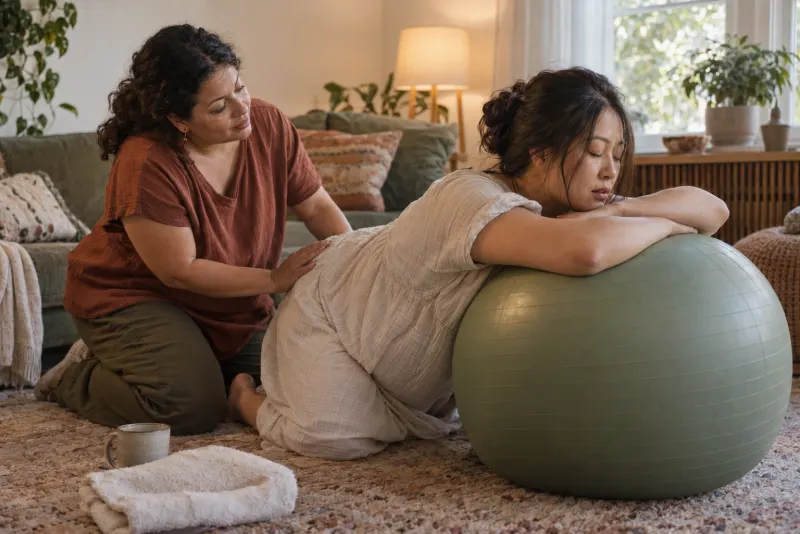
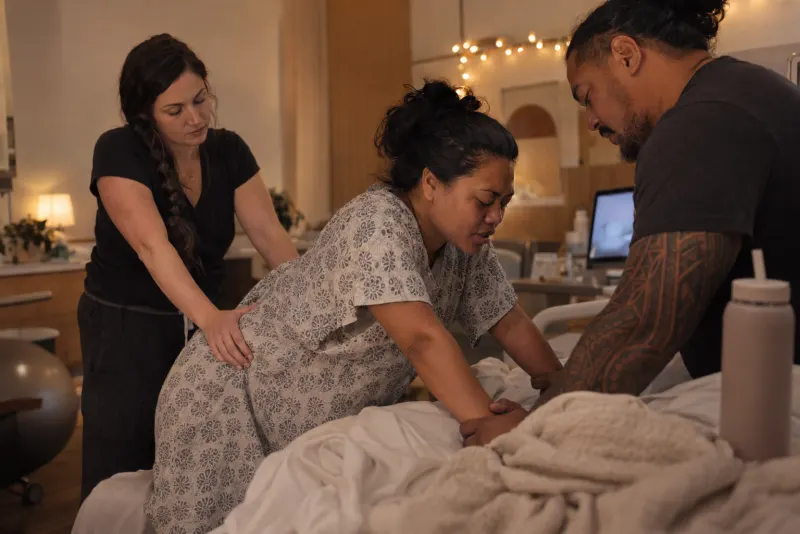
- Hands-on comfort: massage, counter-pressure, position changes, help in the shower or tub
- Keeping you calm, fed and hydrated when your care team allows it
- Helping you understand what's happening so you can make your own decisions. DONA's standards say the doula fosters "client autonomy" and amplifies your voice "within the broader care team" [2]
- Supporting your partner, who may need breaks and reassurance too
Right after birth
- Help with the first feeding and skin-to-skin time
- A follow-up visit to talk through the birth
What doulas don't do
This is the line that matters most, and it's the main difference between a doula and a midwife.
| A doula does | A doula doesn't |
|---|---|
| Comfort measures and emotional support | Vaginal exams, blood pressure checks or fetal heart monitoring |
| Explain options so you can ask informed questions | Diagnose problems or give medical advice |
| Help you speak up with your care team | Make decisions for you or overrule your clinicians |
| Support your partner and family | Deliver the baby |
| Refer you to other help when you need it | Prescribe or give medication |
DONA's standards say doula support "is non-medical and shall not be construed as medical advice," and that the client keeps "all autonomy in decision-making" [2]. If a doula is also a nurse or massage therapist, DONA requires them to make clear that those skills are a separate service [2].
Your midwife or physician and the nursing staff are responsible for your clinical care. A doula works alongside them.
Birth, postpartum and full-spectrum doulas
| Type | When | Main focus |
|---|---|---|
| Birth (labor) doula | Late pregnancy through labor and the first hours after birth | Comfort, information and continuous support in labor [1] |
| Postpartum doula | The weeks and months after birth, mostly in your home | Your recovery, infant feeding, newborn care, sleep and household adjustment [3] |
| Full-spectrum doula | Any pregnancy outcome | Support through birth, miscarriage, stillbirth or abortion |
Postpartum doulas also stay non-clinical. DONA's postpartum standards cover "physical recovery, emotional transition, sleep, nutrition, household organization, and family adjustment," plus help with newborn care, feeding and sibling adjustment [3]. Our guide to postpartum doulas covers that role in detail.
Full-spectrum care is starting to appear in public coverage. New York's Medicaid doula benefit, for example, covers visits for up to 12 months "after the pregnancy ends — no matter how the pregnancy ends" [10].
Does having a doula make a difference?
The strongest evidence is for continuous support in labor. A 2017 Cochrane review pooled 26 randomized trials with 15,858 women [4]. Compared with usual care, women who had continuous one-to-one support were:
- Less likely to have a cesarean (risk ratio 0.75, about a quarter fewer) [4]
- More likely to have a spontaneous vaginal birth (risk ratio 1.08) [4]
- Less likely to have a forceps or vacuum birth (risk ratio 0.90) [4]
- Slightly less likely to use an epidural or other regional analgesia (risk ratio 0.93) [4]
- In labor for less time, by about 41 minutes on average [4]
- Less likely to rate their birth experience negatively (risk ratio 0.69) [4]
Their babies were also less likely to have a low five-minute Apgar score (risk ratio 0.62) [4]. The reviewers rated several of these findings as low-quality evidence, and they found no harms [4].
Who gives the support seems to matter. In the review's subgroup analysis, continuous support was most effective at reducing cesareans when the person was in a doula role, meaning neither hospital staff nor part of the woman's own family or friends [4].
The American College of Obstetricians and Gynecologists (ACOG) agrees. Its guidance on limiting labor interventions says continuous one-to-one emotional support from trained support personnel, with doulas named as the example, "is associated with improved outcomes for women in labor" when given in addition to regular nursing care [5].
Studies in Medicaid populations point the same way, though they're observational. In a Minneapolis study, doula-supported births had 40.9% lower odds of cesarean delivery after adjusting for other factors [6].
How doulas are trained and certified
Doulas aren't licensed the way midwives and nurses are. Most doula credentials come from private organizations, and certification is voluntary unless a state Medicaid program requires approved training before it will pay [8].
DONA's birth doula certification, as one example, requires [7]:
- A DONA-approved birth doula workshop (16 to 24 hours)
- A childbirth education course (8 hours) and a lactation support course (3 hours)
- Continuous in-person labor support at 3 births, with at least 15 hours of labor support in total
- Required reading and a packet submitted within 3 years of the workshop
Other national certifying bodies have their own training paths, such as CAPPA's labor doula (CLD) and postpartum doula (CPD) certifications [11] and ICEA's birth doula (ICBD) and postpartum doula (ICPD) certifications [12]. Many experienced doulas also trained through community-based programs. A credential tells you someone completed training. It doesn't tell you whether they're a good fit for you. Our guide on how to choose a doula has the interview questions.
How doulas get paid by Medicaid
As of September 2026, 28 states and Washington, DC, were paying doulas through Medicaid, and three more states (Nebraska, New Hampshire and Vermont) had approved coverage that wasn't paying yet [13]. As of March 2026, at least 17 states covered doula services through 12 months postpartum, and payment for labor and delivery support ranged from $459 to $1,500 across states [8].
To bill Medicaid or any insurer, a doula needs a National Provider Identifier (NPI) [8]. Doulas can bill individually with a Type 1 NPI, and doula groups can enroll with a Type 2 NPI [8]. The federal provider taxonomy has had its own "Doula" code (374J00000X) since 2009 [9]. That's why so many doulas now show up in the federal NPI registry, which is the data our directory is built on.
States usually require doulas to finish a state-approved training program or qualify through a work-experience pathway before they can enroll [8]. Visit limits and covered services vary by state. See our doula Medicaid coverage by state page for your state's rules, and how much a doula costs if you're paying privately.
How to find a doula near you
- Decide which kind you need. Birth, postpartum or both. Some doulas offer packages that cover both.
- Check coverage first. If you have Medicaid in a state that covers doulas, ask for doulas enrolled with your plan.
- Search by location. Browse doulas by state, including doulas who bill Medicaid where states publish their lists.
- Interview two or three. Ask about availability around your due date, backup coverage, fees and what's included in writing.
If you're weighing a doula against a midwife, or wondering whether you need both, read doula vs midwife.
Questions people ask
Can a doula deliver my baby?
No. Doulas don't perform clinical tasks such as exams, monitoring or delivery. Your midwife or physician delivers the baby and the nurses handle clinical care. The doula's job is comfort, information and support.
Do I need a doula if my partner will be there?
They do different jobs, and many doulas support the partner too. In the Cochrane review, the drop in cesareans was largest when the support person was neither hospital staff nor a friend or relative, which describes a doula.
Does insurance or Medicaid pay for a doula?
Medicaid pays for doula care in 28 states and DC as of September 2026, usually with a cap on visits. Private plans vary, so ask your insurer what it covers before you sign a contract.
What is a full-spectrum doula?
A doula who supports people through any pregnancy outcome, including miscarriage, stillbirth and abortion, not only birth. New York's Medicaid doula benefit, for example, applies no matter how the pregnancy ends.
Are doulas and midwives the same thing?
No. A midwife is a licensed clinician who provides prenatal care and delivers babies. A doula is a non-medical support person. You can have both at the same birth.
Sources
Numbers in brackets in the guide link to these sources.
- 1.What is a Doula?DONA International, 2026
- 2.Birth Doula: Standards of PracticeDONA International, 2025
- 3.Postpartum Doula: Standards of PracticeDONA International, 2025
- 4.Continuous support for women during childbirth (Bohren et al.)Cochrane Database of Systematic Reviews, 2017
- 5.Approaches to Limit Intervention During Labor and Birth (Committee Opinion No. 766)American College of Obstetricians and Gynecologists (ACOG), 2019
- 6.Doula care, birth outcomes, and costs among Medicaid beneficiaries (Kozhimannil et al.)American Journal of Public Health, 2013
- 7.Birth Doula CertificationDONA International, 2026
- 8.State Trends in Medicaid Coverage of Doula ServicesNational Academy for State Health Policy (NASHP), 2026
- 9.Health Care Provider Taxonomy code set, version 26.1National Uniform Claim Committee (NUCC), 2026
- 10.New York State Medicaid Benefit for Doula ServicesNew York State Department of Health, 2024
- 11.Certification pathways: Labor Doula (CLD) and Postpartum Doula (CPD)CAPPA, 2026
- 12.Certification for Doulas and EducatorsInternational Childbirth Education Association (ICEA), 2026
- 13.Doula Medicaid Project: state-by-state chart of doula Medicaid efforts (last updated Sep. 2026)National Health Law Program (NHeLP), 2026