The Mom Site · themomsite.com/costs/diaper-banks/
On this page14 sections
- Key takeaways
- How to find a diaper bank near you
- Why most diaper banks work through partners
- What to bring and typical limits
- How common diaper need is
- Why WIC and SNAP don't cover diapers
- State diaper programs and tax rules
- What NDBN's member list looks like by state
- Period supplies and adult diapers
- Cloth diaper banks
- How to donate or volunteer
- Where to go next
- Questions people ask
- Sources
Key takeaways
- NDBN's member directory lists more than 240 community diaper banks, and our count of it finds a listed member in every state except South Dakota.
- Many diaper banks work like food banks. Nebraska Diaper Bank, for example, says it does not give diapers directly to families and sends you to a partner agency.
- Bring a photo ID and expect to show proof such as a WIC card, a child's Medicaid card or pay stubs. Limits vary: the Queens Diaper Bank gives diapers once every two months per child.
- 40% of U.S. households with a child under 4 in diapers report diaper insecurity, and 62% of low-income households do, according to NDBN's 2026 Diaper Check.
- WIC and SNAP can't buy diapers. TANF cash can, and a few states add their own diaper help.
Searching "diaper bank near me" gets you a mix of food banks, county pages and local news stories, and few of them explain how diaper banks actually work. This guide does. If you need the full list of ways to get diapers without a bank, including Medicaid plan benefits, start with our guide to free diapers. Here we go deeper on diaper banks: how to find one, what to expect when you call, and what else exists around them.
How to find a diaper bank near you
Use these in order. Each one takes a few minutes.
- Call 2-1-1 or search 211.org. The National Diaper Bank Network (NDBN) tells families to ask for "diapers" or "basic needs" and to check the listings under "children." 211 specialists are available 24/7 [1].
- Check NDBN's member directory. It lists the network's community diaper banks by state and city, and each entry links to the bank's own site [2].
- Try findhelp.org. It searches free and reduced-cost programs by ZIP code, including goods such as baby supplies [3].
- Ask food pantries and faith-based organizations. NDBN suggests these when 211 turns up nothing [1].
- Ask your WIC office, pediatrician or hospital social worker. They often know which pantry has diapers this month. WIC staff make referrals to other services [4].
When you reach a person, ask: "Where is the nearest place I can pick up diapers, and what do I need to bring?"
Why most diaper banks work through partners
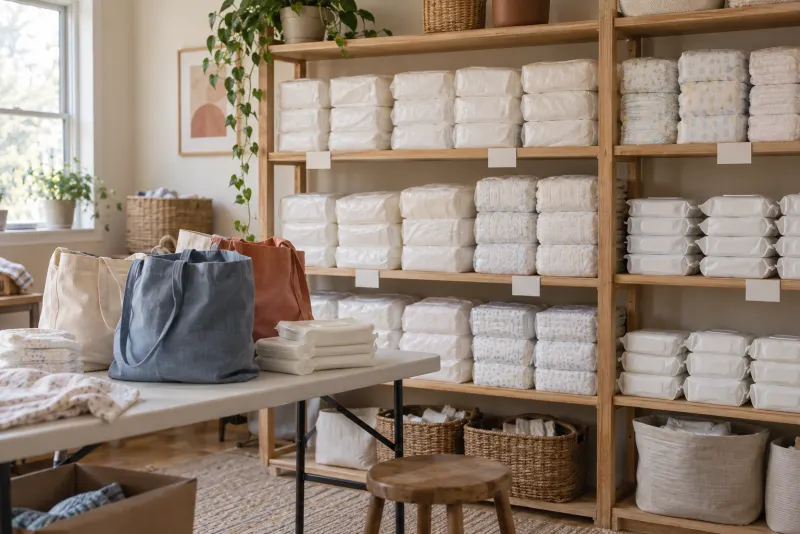
A diaper bank is a warehouse. It collects and stores diapers, then moves them out in bulk. Many hand them to local agencies instead of to families directly, the same way a regional food bank supplies neighborhood pantries.
Nebraska Diaper Bank is a clear example. Its "I Need Diapers" page says it does not provide diapers directly to families, and that partner agencies hand them out through case management, clinics and food pantries. Some of its partner sites take walk-ins. Others serve only people already enrolled in their programs [5]. Indiana Diaper Bank also supplies local pantries and a network of distribution centers, and warns that diapers aren't always in stock at every location, so call before you go [6].
Some banks do serve families themselves, usually in their home area and with an application. Texas Diaper Bank's Parenting Essentials program gives diapers every quarter to low-income families with a child 0 to 36 months old, and refers people outside its service area to other Texas diaper banks [7][8].
So the pickup spot may be a food pantry, a church, a family resource center or a WIC clinic, not a building labeled "diaper bank."
What to bring and typical limits
Rules are local and they change, so treat the table below as examples, not a national standard. Every row comes from the bank's or a local resource directory's own description.
| Program | How you get diapers | Who qualifies | What to bring / limit |
|---|---|---|---|
| Nebraska Diaper Bank | Through partner agencies only, some walk-in and some enrollment-only [5] | Children up to their 3rd birthday, in a family with financial need | Parent or guardian present with photo ID. You may need a WIC card, the child's Medicaid card or pay stubs [5] |
| Queens Diaper Bank (New York) | Appointment, first come first served, open two days a month [9] | WIC, SNAP or Medicaid participants | Proof of identity for each child (insurance or Medicaid card, vaccination card, birth certificate or hospital discharge papers) plus proof of Medicaid, WIC or SNAP. Diapers once every two months per child, newborn to size 7 [9] |
| Texas Diaper Bank (San Antonio area) | Parenting Essentials program | Child 0 to 36 months old, with basic income requirements | Diapers and essentials every quarter [7][8] |
| Indiana Diaper Bank | Local pantries and distribution centers | Set by each partner | Call ahead. Stock isn't guaranteed at every location [6] |
Two habits save a wasted trip. Call before you go, and ask whether you need to be registered in advance. Also ask what sizes are in stock. NDBN says a child needs at least 50 diaper changes a week, or 200 a month [10], so ask how many diapers a visit covers.
How common diaper need is
Diaper need is not rare. NDBN's 2026 Diaper Check surveyed 1,006 U.S. households with a child under 4 in diapers [11]:
- 40% of those households report diaper insecurity.
- 62% of low-income households (income up to 200% of the federal poverty guideline) report it.
- 78% of households with diaper insecurity held a job in the past 12 months.
- 34% of them have skipped meals to afford diapers, and 29% have delayed a rent or mortgage payment.
- Their odds of missing work because they lacked diapers for child care were 21 times those of households without diaper insecurity.
NDBN commissioned the survey, so read it as the network's own research. It was fielded by SSRS and published April 15, 2026 [11].
If you're short on diapers, you're not the exception. The bigger question is which benefits you can pair with a diaper bank. Our benefits checker shows whether you may qualify for Medicaid or WIC, which can free up cash for diapers.
Why WIC and SNAP don't cover diapers
SNAP buys food only. USDA lists nonfood items it can't buy, including paper products, household supplies and hygiene items [12]. WIC covers specific foods, nutrition education and breastfeeding support [4]. NDBN says plainly that neither program can be used to buy diapers [13].
Two things do help:
- TANF cash assistance can be spent on diapers. But NDBN reports that only 23% of families living below the federal poverty level receive TANF nationwide [13].
- WIC is still worth having. Infant formula is part of a WIC food package, which frees up money for diapers [21], and the WIC office may know the local diaper pantry [4]. See our WIC guide for how to apply.
State diaper programs and tax rules
A few states pay for diapers directly or fund diaper banks. NDBN's state tracker, which we checked on October 16, 2026, shows the following [14][15][16].
| State | What exists | Detail |
|---|---|---|
| Tennessee | Diapers through Medicaid | TennCare and CHIP cover up to 100 diapers a month for children under 2. CMS approved it in May 2024 [14][15] |
| Delaware | Postpartum diaper benefit | CMS approved up to 80 diapers and one pack of wipes a week for mothers in the first 12 weeks postpartum, in May 2024 [14] |
| Washington | Diaper Related Payment | A cash payment, capped at $100, added to a TANF or State Family Assistance grant for a household with a child under 3 [16] |
| California | Direct assistance and bank funding | NDBN lists California as one of two states giving direct help, and it funds diaper banks: $16.5 million for fiscal 2026-2027 [14] |
| New Jersey | One-year pilot | Direct help for Work First New Jersey participants, passed in July 2024 [14] |
NDBN says 11 states and DC fund diaper distribution. Besides California and Washington, that includes Colorado, Connecticut, Indiana, Massachusetts, Michigan, Minnesota, New York, Tennessee and Utah, plus DC [14]. If you live in one of them, your local diaper bank may have more supply.
Sales tax on diapers
As of July 11, 2026, 23 states still charge sales tax on diapers, at rates NDBN puts between 4% and 7%, and cities and counties may add more [10]. The states below changed their rules most recently, according to NDBN's tracker [10]. Confirm the details with your state revenue department, because NDBN is an advocacy group and exemptions can have limits, such as the end date on Alabama's.
| State | Change | Effective |
|---|---|---|
| Missouri | Sales tax on diapers eliminated | August 28, 2025 |
| Alabama | Temporary exemption | September 1, 2025 to August 31, 2028 |
| Nevada | Voters exempted diapers | January 1, 2025 |
| Texas | Diapers and other basic necessities exempted | September 1, 2023 |
| Ohio | Diapers tax free | October 1, 2023 |
| North Dakota | Diapers exempted | July 1, 2023 |
| Virginia | Tax on essentials removed | January 1, 2023 |
| Iowa | Diapers exempted | January 1, 2023 |
| Maryland, Indiana | Diapers exempted | July 1, 2022 |
| Colorado | Diaper tax ended | August 10, 2022 |
NDBN also lists California, Connecticut, Florida, Louisiana, Massachusetts, Minnesota, New Jersey, New York and Pennsylvania as having exempted diapers earlier [10]. For benefits and coverage in your own state, see having a baby in your state.
What NDBN's member list looks like by state
NDBN's directory is the best single national list, but it only covers members. A local pantry or church program may give out diapers without being on it, so use 211 as well. Instead of copying the list, here is our count of what the directory showed on October 16, 2026 [2]. Some programs serve more than one state, so treat the counts as approximate.
| Listed members | States |
|---|---|
| 18 | New York |
| 16 | California |
| 14 | Florida |
| 12 | Washington |
| 10 | Indiana, Pennsylvania, Wisconsin |
| 9 | Massachusetts, Ohio, Texas |
| 1 | Arizona, Arkansas, Idaho, Kentucky, Maine, Nebraska, New Hampshire, North Dakota, Rhode Island, Vermont, DC, Puerto Rico |
| 0 | South Dakota |
A low count doesn't mean no help. Nebraska has one listed member, but its partner network covers many sites across the state [5]. Use the directory for names and links.
Period supplies and adult diapers
Many diaper banks stock more than baby diapers, but it varies, so ask.
- Period products. The Alliance for Period Supplies, which works alongside NDBN, cites a 2021 U by Kotex study finding that two in five people have struggled to afford period products [17]. Texas Diaper Bank runs a separate menstrual supply program [7].
- Adult diapers. Texas Diaper Bank delivers free adult diapers to people 60 and older in its San Antonio-area service counties [7]. Elsewhere, ask 211 for "incontinence supplies."
- Through Medicaid or insurance. NDBN partners with Aeroflow Urology, which provides free incontinence supplies for adults and children who qualify through their insurance, delivered to the home monthly [18]. NDBN lists Aeroflow as a partner, so read this as an option to check, not an endorsement.
Cloth diaper banks
Cloth diapers cost more up front and can be reused. NDBN says cloth diapering isn't a fit for everyone, but it can be a cost-effective way to diaper a child, and many member banks run cloth diaper programs that give diapers and teach families how to use them [13]. When you call, ask: "Do you have a cloth diaper program, and do you offer a starter set?" To estimate how many you'd need, see how many diapers a newborn needs.
How to donate or volunteer
Diaper banks run on donated diapers and money, and most take both.
- Donate diapers. Indiana Diaper Bank takes drop-offs, diaper drives and registry purchases [19]. Call your local bank to confirm which sizes it needs most.
- Donate money. Banks buy in bulk. Indiana Diaper Bank says $6 provides an emergency supply of diapers for one baby [19], and Texas Diaper Bank says every $1 can help provide 5 diapers through its partner program [8].
- Host a drive. Texas Diaper Bank invites groups to host a September diaper drive [7].
- Volunteer. Find your local bank in NDBN's directory [2] and ask about volunteer shifts. Texas Diaper Bank lists individual and corporate volunteering [7].
Where to go next
Diaper banks cover part of the gap, not all of it. For the rest of the baby budget, see our guide to free baby stuff from real programs, including Medicaid plan extras, and the broader guide to free diapers for every route outside the bank system. Make your first call to 2-1-1 today, ask for diapers by name, and write down the pickup site and what to bring before you go.
Questions people ask
How do I find a diaper bank near me?
Call 2-1-1 or search 211.org and ask for diapers or basic needs, then check NDBN's member directory, which is listed by state and city. If neither turns up a site, try findhelp.org with your ZIP code, local food pantries and faith-based organizations.
Can I walk into a diaper bank and get diapers?
Sometimes. Many diaper banks distribute only through partner agencies such as pantries, clinics and family resource centers, and some partner sites serve only people enrolled in their programs. Call first and ask where the nearest pickup site is.
What do I need to bring to get free diapers?
A photo ID is the most common requirement. Programs also ask for proof of your child, such as a birth certificate or Medicaid card, and proof of need, such as a WIC or Medicaid card, SNAP proof or pay stubs. Ask when you call, since each program sets its own list.
How many diapers can I get, and how often?
It depends on the bank. The Queens Diaper Bank in New York gives diapers once every two months per child, and Texas Diaper Bank's program supplies diapers every quarter for children 0 to 36 months. Ask your local site.
Do diaper banks give out period products and adult diapers?
Many do, but not all. Texas Diaper Bank, for example, runs a menstrual supply program and a senior program that delivers free adult diapers to people 60 and older in its service area. Call your local bank and ask what it stocks.
Sources
Numbers in brackets in the guide link to these sources.
- 1.Get Help NowNational Diaper Bank Network
- 2.Member Diaper BanksNational Diaper Bank Network
- 3.Findhelp: search and connect to social careFindhelp
- 4.WIC BenefitsUSDA Food and Nutrition Administration
- 5.I Need DiapersNebraska Diaper Bank
- 6.Get DiapersIndiana Diaper Bank
- 7.Free DiapersTexas Diaper Bank
- 8.Parenting EssentialsTexas Diaper Bank
- 9.Get free diapers (Queens Diaper Bank)Public Health Solutions, via 1degree
- 10.Diaper TaxNational Diaper Bank Network, 2026
- 11.The NDBN Diaper Check 2026: Diaper Insecurity among U.S. Children and FamiliesNational Diaper Bank Network, 2026
- 12.SNAP Eligible Food ItemsUSDA Food and Nutrition Administration
- 13.The NeedNational Diaper Bank Network
- 14.State IssuesNational Diaper Bank Network, 2026
- 15.Diapers (TennCare Diaper Benefit)TennCare, Tennessee Division of TennCare
- 16.Diaper Related Payment (DRP)Washington State Department of Social and Health Services (DSHS)
- 17.Period PovertyAlliance for Period Supplies
- 18.Receive Free Diapers and Other Incontinence Supplies Through MedicaidNational Diaper Bank Network (Aeroflow Urology partnership)
- 19.Indiana Diaper BankIndiana Diaper Bank
- 20.About UsUnited Way 211
- 21.WIC Food Packages: Regulatory Requirements for WIC-Eligible FoodsUSDA Food and Nutrition Administration