The Mom Site · themomsite.com/choosing-care/night-nurse-vs-postpartum-doula/
On this page14 sections
- Key takeaways
- Night nurse vs newborn care specialist vs postpartum doula: what's the difference?
- Is a night nurse a real nurse?
- What does a night nanny do?
- What is a newborn care specialist?
- What does a postpartum doula do?
- What training and certification does each one need?
- How much does each one cost?
- Does insurance or Medicaid pay for any of them?
- Which one should you choose?
- How do you hire overnight help safely?
- Where to find each one
- Questions people ask
- Sources
Key takeaways
- "Night nurse" is usually a nickname. A real night nurse is a licensed RN or LPN, and states such as Florida make it a crime to use those titles without a license.
- A night nanny follows your lead overnight and typically has no formal newborn training. A newborn care specialist focuses on babies 0 to 16 weeks. A postpartum doula supports the whole family, including your recovery.
- Night nannies average $22.50 to $27.61 an hour on Care.com (October 2026), newborn care specialists reported a $35 median in the INA's 2022 survey, and postpartum doulas charge about $30 to $50 an hour, plus $5 to $15 for awake overnights.
- DONA International's postpartum doula certification requires a 27-hour-plus workshop and at least 12 hours of support for each of 3 families. Its doulas don't perform clinical or medical tasks.
- Health insurance and HSAs don't pay for care of a healthy baby. As of October 2026, 28 states and DC pay for doula care through Medicaid, and as of March 2026 at least 17 states covered it through 12 months postpartum.
At a glance
Night nurse or night nanny
Suits: Families who mainly want someone to handle overnight feeds and settling so they can sleep, at the lowest hourly rate.
- Strength: Lowest typical hourly rate of the three
- Strength: Follows your routines and feeding plan
- Strength: Easy to book a few nights a week
- Trade-off: Usually not a licensed nurse, despite the name
- Trade-off: Typically no formal newborn or postpartum training
- Trade-off: Cares for the baby only, not your recovery
- Trade-off: Not covered by insurance, HSAs or Medicaid
Newborn care specialist
Suits: Families who want an experienced overnight baby expert for the first weeks, including help with feeding schedules and sleep routines.
- Strength: Focuses on babies in the first 0 to 16 weeks
- Strength: Often has newborn, sleep or lactation training
- Strength: Many offer overnight care as their main service
- Trade-off: Training is voluntary and varies; there's no state license
- Trade-off: Higher rates than night nannies
- Trade-off: Busy specialists book months ahead
- Trade-off: Not covered by insurance or Medicaid
Postpartum doula
Suits: Parents who want support for their own recovery, feeding and emotional adjustment, by day or overnight, along with newborn care.
- Strength: Supports the whole family, including your recovery
- Strength: Trained to spot when you need medical or mental health care
- Strength: Day visits or overnights
- Strength: Medicaid pays for visits in many states
- Trade-off: Usually the highest hourly rate, especially overnight
- Trade-off: Non-medical: no clinical tasks
- Trade-off: Medicaid visit limits are small, so most families still pay privately
The short answer: most people advertised as a "night nurse" aren't nurses. They're night nannies or newborn care specialists who look after your baby overnight so you can sleep. A postpartum doula also cares for the baby, but is trained to support you as well: your recovery, feeding and emotional adjustment [1][2].
A true night nurse is a licensed registered nurse (RN) or licensed practical nurse (LPN). The Newborn Care Specialist Association says that kind of in-home nursing may be appropriate when a newborn is medically fragile [1]. For a healthy baby, you're usually choosing between the other three.
Here's how they compare on training, what they do, cost and who pays.
Night nurse vs newborn care specialist vs postpartum doula: what's the difference?
The difference is who they're there for and what training sits behind the title. A night nanny and a newborn care specialist focus on the baby. A postpartum doula focuses on the whole family. Only a licensed RN or LPN is actually a nurse [1].
| Night nanny ("night nurse") | Newborn care specialist (NCS) | Postpartum doula | Licensed night nurse (RN or LPN) | |
|---|---|---|---|---|
| Main focus | Overnight baby care, following the parents' lead [1] | Babies in the first 0 to 16 weeks [1] | The family as a whole, including the parent's recovery [1][2] | Newborns, including medically fragile babies [1] |
| Training | Typically no professional newborn or postpartum training [1] | Newborn care training and voluntary credentials from private groups [1][4] | Postpartum doula training; DONA certification takes a 27+ hour workshop plus supervised experience [3] | State nursing license [1][8] |
| Medical tasks | No | No | No. DONA doulas don't perform clinical or medical tasks [2] | Yes, within their license |
| Typical rate | $22.50 to $27.61 an hour (Care.com, Oct. 2026) [6] | $35 an hour median (INA, 2022) [5] | About $30 to $50 an hour, plus $5 to $15 for awake overnights [7] | Usually billed through a home health agency |
| Day or night | Mostly nights | Mostly nights; some 24-hour care | Day visits, overnights or both | Either |
| Insurance or Medicaid | No | No | Medicaid in many states [13] | Medicaid private-duty nursing if medically necessary [12] |
The titles overlap in real life. A caregiver may call herself a night nurse in an ad, list herself as an NCS on an agency site, and hold a postpartum doula certificate too. Ask what training each person has, rather than relying on the label.
Is a night nurse a real nurse?
Usually not. "Night nurse" or "baby nurse" is a common nickname for overnight newborn help. The Newborn Care Specialist Association reserves the term for a licensed RN or LPN who works with newborns, and says a newborn care specialist "cannot ethically or legally" call themselves a nurse without a nursing degree [1].
States protect nursing titles by law. Florida, for example, lets only people holding a Florida or multistate license use the titles "Registered Nurse," "R.N.," "Licensed Practical Nurse" or "L.P.N." Violating that rule is a first-degree misdemeanor [8].
If someone tells you they're a nurse, check. Nursys, run by the National Council of State Boards of Nursing, lets you look up a nurse's license and discipline status for free through its QuickConfirm tool, for boards that take part [9]. You can also search your state board of nursing's website.
When do you actually need a licensed nurse at night? Generally only when a baby comes home with medical needs, such as feeding equipment, oxygen or medications that need skilled care. That's a conversation for your baby's doctor and the hospital discharge team, not something to sort out through a nanny agency.
What does a night nanny do?
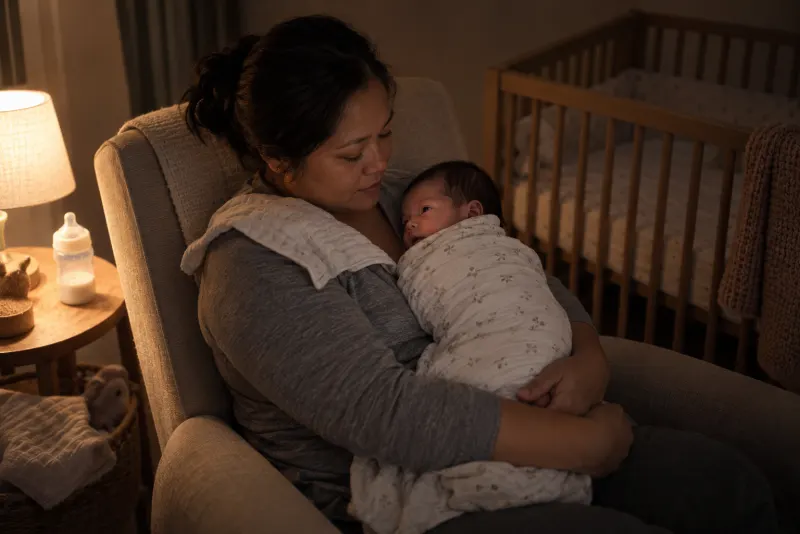
A night nanny takes the overnight shift with your baby so you can sleep. They follow your routines and feeding plan rather than setting their own [1].
A typical night might include:
- Feeding the baby a bottle, or bringing the baby to you to breastfeed and then settling them back down
- Diaper changes, burping and soothing
- Washing bottles and pump parts
- Keeping a log of feeds, diapers and sleep for you in the morning
The Newborn Care Specialist Association notes that night nannies typically have no professional newborn or postpartum training or certifications [1]. Many are experienced caregivers, but experience varies a lot from person to person. If you're hiring someone without formal newborn training, ask specifically about safe sleep and infant CPR.
What is a newborn care specialist?
A newborn care specialist (NCS) is an in-home caregiver who specializes in babies in the first 0 to 16 weeks of life [1]. Many work mostly overnight. In the International Nanny Association's 2022 survey, 79.8% of newborn care specialists said overnight care was part of their typical role [5].
An NCS does everything a night nanny does, with more focus on the newborn stage. The Newborn Care Specialist Association says they help troubleshoot concerns about a newborn's health or development, and may bring extra skills such as lactation support, sleep shaping and perinatal mental health awareness through additional training [1]. In practice, many help set up feeding and sleep routines that parents can continue after the engagement ends.
There's no state license for newborn care specialists that we could find. Training and credentials are voluntary and come from private organizations. One example is the International Nanny Association's NCS Credential Exam, which tests knowledge of infant safety, nutrition, development, sleep, general care, illnesses and professionalism, and requires current first aid and infant CPR certification to sit for it [4].
In the INA's 2022 survey of newborn care specialists [5]:
- About two-thirds reported entry-level or advanced NCS training
- About half reported sleep consulting training, and close to half reported lactation training
- 40% reported entry-level postpartum doula training
- 3% reported no NCS-specific training
That spread is why it pays to ask each candidate exactly which courses they've taken and from whom. A certificate from a weekend course and years of overnight experience aren't the same thing.
What does a postpartum doula do?
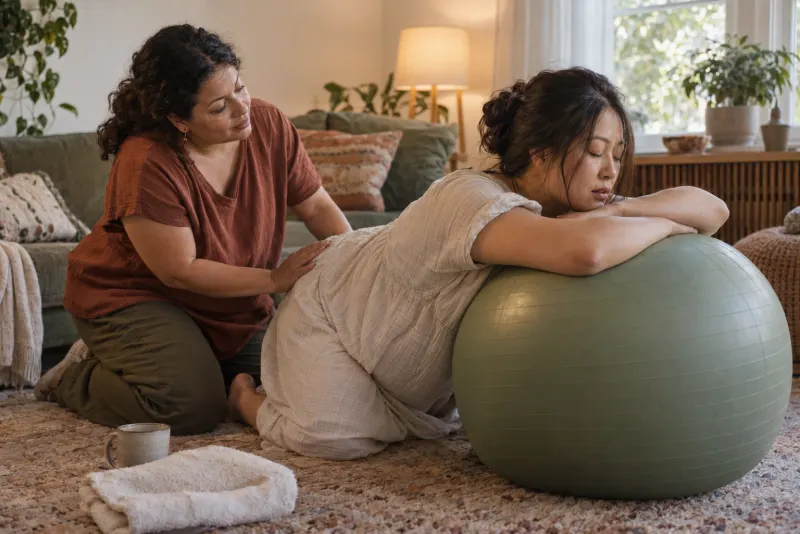
A postpartum doula gives non-medical support to the whole family, usually at home, by day or overnight. DONA International's standards describe it with four principles: nurture, educate, assess or advocate, and refer [2]. The doula nurtures the family, teaches about lactation, sleep and newborn care, and makes referrals when a need is beyond their training [2].
Compared with a night nanny or NCS, the big difference is that a postpartum doula looks after you, not only the baby [1]. That can mean:
- Checking in on how you're recovering physically and emotionally
- Feeding support for breastfeeding, pumping or bottles
- Holding the baby while you shower, eat or nap
- Light housework and simple meals
- Helping older siblings adjust
- Noticing signs of postpartum depression or anxiety and helping you reach care
DONA's standards are clear that its postpartum doulas "do not perform clinical or medical tasks" and won't diagnose or treat [2]. So a doula won't check your incision or take your baby's vitals the way a nurse would.
For a full rundown, see our guide to what a postpartum doula does. If feeding is the main problem, a lactation consultant is the right next step: see what an IBCLC is.
What training and certification does each one need?
None of the three non-nurse roles is licensed. What differs is the training that typically sits behind each title.
| Role | Common training or credential | What it involves |
|---|---|---|
| Night nanny | None required [1] | Varies. Ask about infant CPR and safe sleep |
| Newborn care specialist | Private NCS training; credentials such as the INA NCS Credential Exam [4] | Exam on infant safety, nutrition, development, sleep, care and illness; first aid and infant CPR required to apply [4] |
| Postpartum doula | Doula training; certification from groups such as DONA International [3] | DONA: 27+ hour workshop, an equity webinar, at least 3 families supported within 12 weeks of birth with at least 12 hours and 3 visits per family, client evaluations and a signed scope of practice [3] |
| Licensed night nurse | State RN or LPN license [8] | Nursing education plus a state license, which you can verify [9] |
Certification isn't the only sign of skill. Many experienced postpartum doulas and newborn care specialists have worked for years with no certificate at all. But a credential tells you the person has met a defined standard, and a doula certified by a group like DONA has agreed to a written scope of practice [3].
How much does each one cost?
Night nannies are usually the least expensive, newborn care specialists are in the middle, and postpartum doulas, especially overnight, usually cost the most.
| Who you hire | Typical rate | 10-hour night |
|---|---|---|
| Night nanny | $22.50 to $27.61 an hour, Care.com national average, October 2026 [6] | About $225 to $276 |
| Newborn care specialist | $35 an hour median, INA 2022 survey [5] | About $350 |
| Postpartum doula, overnight | About $30 to $50 base, plus $5 to $15 an hour for awake overnights [7] | About $350 to $650 |
Rates are higher in big cities, for twins and through agencies, which add their own margin. The INA figure is from 2022, so current rates may be higher. For the full math on a week or a month of nights, see night nurse cost. For daytime visits and package pricing, see postpartum doula cost.
If you hire someone directly, budget for taxes too. Social Security and Medicare taxes apply to household workers you pay $3,000 or more in cash wages in 2026, at 7.65% each for you and the worker [10]. A worker an agency provides isn't your employee if the agency controls what work is done and how [10]. And a caregiver who alone controls how the work is done is self-employed, not your employee [10]. Our nanny cost guide walks through household employer basics.
Does insurance or Medicaid pay for any of them?
Insurance won't pay for a night nanny or newborn care specialist to look after a healthy baby. Medicaid pays for postpartum doula visits in many states, and for private-duty nursing only when there's a medical need.
Night nannies and newborn care specialists. Health insurance covers medical care, and the IRS says you can't count amounts you pay for the care of children as a medical expense, under a heading that specifically includes nursing services for a normal, healthy baby [11]. That rules out HSA and health FSA money for routine newborn care too. The IRS does count nursing services for a medical condition, even when the person isn't a nurse, as long as the services are the kind a nurse would generally do [11]. If you're recovering from a complicated birth, ask your HSA or FSA administrator what qualifies.
Licensed night nurses. Federal Medicaid rules define private-duty nursing as care for people who need more individual and continuous care than a visiting nurse or a hospital's routine staff can provide. It has to be provided by an RN or LPN under the direction of the patient's physician [12]. It's meant for babies or parents with real medical needs, not routine nights.
Postpartum doulas. As of October 2026, 28 states and DC pay for doula care through Medicaid, by our state-by-state tracker and the National Health Law Program's September 2026 chart [15]. As of March 2026, NASHP counted at least 17 states paying for doula services through 12 months postpartum [13]. Most states cap the number of visits. Oregon, for example, includes two postpartum visits plus up to four more prenatal or postpartum visits [13]. Check doula Medicaid coverage by state for your state's rules, and our guide to whether insurance covers doulas for private plans.
If you'll use a dependent care FSA, the rules turn on whether the care lets you work. Overnight help during parental leave usually won't qualify. See our dependent care FSA guide before you count on it.
Which one should you choose?
Pick based on what you actually need help with. Sleep alone points to a night nanny or newborn care specialist. Help with your own recovery and feeding points to a postpartum doula.
A night nanny may fit if:
- Feeding is going well and you mainly need sleep
- You're comfortable directing the routines yourself
- Budget is the deciding factor
A newborn care specialist may fit if:
- You want an experienced newborn expert overnight in the first weeks
- You'd like help building a feeding and sleep routine
- You have twins or a baby who's hard to settle
A postpartum doula may fit if:
- You're recovering from a cesarean or a hard birth
- You're learning to breastfeed or pump and want hands-on support
- You want someone who will notice if you're struggling emotionally
- You'd like daytime help, or a mix of days and nights
- Your state's Medicaid program covers doula visits
A licensed nurse makes sense if:
- Your baby comes home with medical needs your doctor says call for skilled nursing
Many families combine them: a postpartum doula for daytime visits in the first weeks, plus a night nanny or NCS a few nights a week. If mood is a concern, don't wait for a caregiver to notice. Our guide to getting help for postpartum depression lists where to start.
How do you hire overnight help safely?
Start early, check credentials, and agree on safe sleep rules in writing. Overnight caregivers are alone with your baby while you sleep, so this is worth the extra steps.
Book during pregnancy. In the INA's 2022 survey, 44% of newborn care specialists usually booked clients 1 to 3 months ahead, and another 25% booked 3 to 5 months ahead [5]. Popular postpartum doulas book up too.
Verify any nursing claim. If someone says they're an RN or LPN, look up the license on Nursys or your state board of nursing [9].
Ask about training. Ask which newborn care or doula courses they've taken, whether they're certified, and whether their infant CPR and first aid certification is current. The INA requires current first aid and infant CPR certification to apply for its NCS credential [4].
Go over safe sleep together. The AAP says to place babies on their back for every sleep, on a firm, flat surface, with no soft objects or loose bedding, and to room-share without bed-sharing for at least the first 6 months [14]. Make sure your caregiver follows those rules, including never falling asleep with the baby on a couch or armchair. Ask your pediatrician about anything specific to your baby.
Talk through feeding. Decide whether they'll bring the baby to you to nurse, give pumped milk or give formula, and how they'll handle a baby who won't settle.
Get it in writing. A written agreement should cover the hourly rate, shift length, minimum nights, deposit and cancellation terms, overnight or twin premiums, and who covers if they're sick.
Sort out taxes. Ask whether they work through an agency, as an independent business, or as your employee. That decides who handles payroll taxes [10].
Check references. Ask for recent families with a baby of a similar age.
Where to find each one
Postpartum doulas are easiest to find through doula directories and referrals from your hospital, birth center or midwife. You can browse doulas by state, and our guide on how to choose a doula has interview questions and contract tips.
Night nannies and newborn care specialists usually come through nanny agencies, newborn care agencies, caregiver websites and word of mouth. In the INA's 2022 survey, 69% of newborn care specialists said they found their positions by word of mouth [5], so ask friends, parent groups and your prenatal class.
Whichever you choose, keep your own postpartum care appointments and your baby's checkups. Overnight help is there for rest and support. It doesn't replace your doctor, midwife or pediatrician.
Questions people ask
What is the difference between a night nurse and a postpartum doula?
A true night nurse is a licensed RN or LPN, which you'd usually only need for a baby with medical needs. Most people called night nurses are night nannies or newborn care specialists who care for the baby overnight. A postpartum doula cares for the baby too, but also supports your recovery, feeding and emotional adjustment.
How much does a night nurse cost?
Night nannies average $22.50 to $27.61 an hour on Care.com (October 2026), and newborn care specialists reported a $35 median in a 2022 survey. A 10-hour night runs roughly $225 to $350 before agency fees or payroll taxes. Overnight postpartum doulas usually cost more.
Does insurance cover a night nurse or newborn care specialist?
Not for routine care of a healthy baby. The IRS says care for a normal, healthy baby isn't a medical expense. Medicaid's private-duty nursing benefit only covers continuous skilled nursing by an RN or LPN, directed by a doctor.
Does Medicaid cover a postpartum doula?
In many states. As of October 2026, 28 states and DC pay for doula care through Medicaid, and as of March 2026 at least 17 covered it through 12 months after birth. Most limit the number of visits, and the doula must be enrolled with your state's program.
How do I find a postpartum doula or night nurse near me?
Search a doula directory by state for postpartum doulas, ask your hospital or birth center for referrals, and ask newborn care agencies for night nannies and newborn care specialists. If anyone says they're a nurse, check their license on Nursys or your state board of nursing.
When should I book a night nanny or postpartum doula?
During pregnancy. In the INA's 2022 survey, 44% of newborn care specialists usually booked clients 1 to 3 months ahead and another 25% booked 3 to 5 months ahead.
Sources
Numbers in brackets in the guide link to these sources.
- 1.NCS, PPD, Night Nurse, Night Nanny: What's the Difference?Newborn Care Specialist Association, via the International Nanny Association, 2024
- 2.Postpartum Doula: Standards of PracticeDONA International, 2025
- 3.Postpartum Doula CertificationDONA International, 2026
- 4.INA Newborn Care Specialist Credential ExamInternational Nanny Association (INA), 2026
- 5.2022 INA Nanny and NCS Salary and Benefits SurveyInternational Nanny Association (INA), 2023
- 6.Night nanny cost in Houston, TX (national average table)Care.com, 2026
- 7.How much does a doula cost?Partum Health, 2026
- 8.Fla. Stat. 464.015, Titles and abbreviations; restrictions; penaltyFlorida Legislature, 2026
- 9.Nursys QuickConfirm license verificationNational Council of State Boards of Nursing (NCSBN), 2026
- 10.Publication 926: Household Employer's Tax Guide (for use in 2026)Internal Revenue Service (IRS), 2026
- 11.Publication 502: Medical and Dental ExpensesInternal Revenue Service (IRS), 2025
- 12.42 CFR 440.80, Private duty nursing servicesLegal Information Institute, Cornell Law School (Code of Federal Regulations)
- 13.State Trends in Medicaid Coverage of Doula ServicesNational Academy for State Health Policy (NASHP), 2026
- 14.A Parent's Guide to Safe SleepAmerican Academy of Pediatrics (HealthyChildren.org), 2026
- 15.Doula Medicaid Project: state-by-state chart of doula Medicaid efforts (last updated Sep. 2026)National Health Law Program (NHeLP), 2026