The Mom Site · themomsite.com/costs/placenta-encapsulation-cost/
On this page9 sections
Key takeaways
- Published price lists we checked in October 2026 charged $225 to $397 for encapsulation with pickup, and $150 when bundled with doula care.
- Add-ons cost extra: $25 to $75 for a tincture, salve, print or gummies on one provider's list, plus travel fees outside the service area.
- Hospitals set their own release rules. UNC Hospitals, for example, requires a signed authorization, and disposes of a placenta left on the unit more than 8 hours.
- In 2017, the CDC reported a newborn's group B strep infection linked to the mother's placenta capsules and said capsule ingestion should be avoided. It noted that no standards exist for processing placenta for consumption.
- A 2017 review in the American Journal of Obstetrics & Gynecology found no scientific evidence of a clinical benefit and said physicians should discourage the practice.
There's no national survey of what placenta encapsulation costs, so we went to providers' own published price lists. In October 2026, they charged $225 to $397 for encapsulation with pickup, depending on the package and the area [1][2]. One specialist charged her own doula clients $150 [2]. Add-ons like a tincture, salve or placenta print cost $25 to $75 more on one provider's list [1].
Before you book, know two things. Your hospital has to agree to release the placenta, and rules vary [3][7]. And in 2017, the CDC reported a newborn's infection linked to the mother's placenta capsules and said capsule ingestion should be avoided [4]. We don't make claims about health benefits; a medical review found no scientific evidence of any [5].
How much does placenta encapsulation cost?
| Provider | Service area | What's included | Price |
|---|---|---|---|
| April's Doula Services [1] | Upstate South Carolina and Delmarva (DE, MD, VA) | Pickup, steaming and dehydrating, vegan capsules, dosing and storage instructions, shipping | $249 (classic capsules) |
| April's Doula Services [1] | Same | Classic package plus a placenta print, a tincture or salve, and delivery | $297 to $397 (deluxe and premium packages) |
| Jaymee F. Payan [2] | Ventura County, California | Pickup, steaming, dehydrating, capsules, storage container, written instructions, delivery within 72 hours, dried cord keepsake | $225 to $250 by area; $150 for her doula clients |
Prices as listed when we checked in October 2026. Neither is a national average, so get two or three local quotes.
Add-ons and extra fees on the South Carolina provider's list [1]:
- Tincture: $40
- Salve: $25
- Cord keepsake: $40
- Placenta print: $35
- Gummies or chocolates: $75 each
- Travel: $50 beyond 60 miles and $100 beyond 90 miles; overnight shipping $75
Deposits. The California specialist takes a $100 nonrefundable deposit by 38 weeks of pregnancy, with the balance due when the capsules are delivered 1 to 3 days after the birth [2].
What's included in placenta encapsulation
Most packages follow the same steps [1][2]:
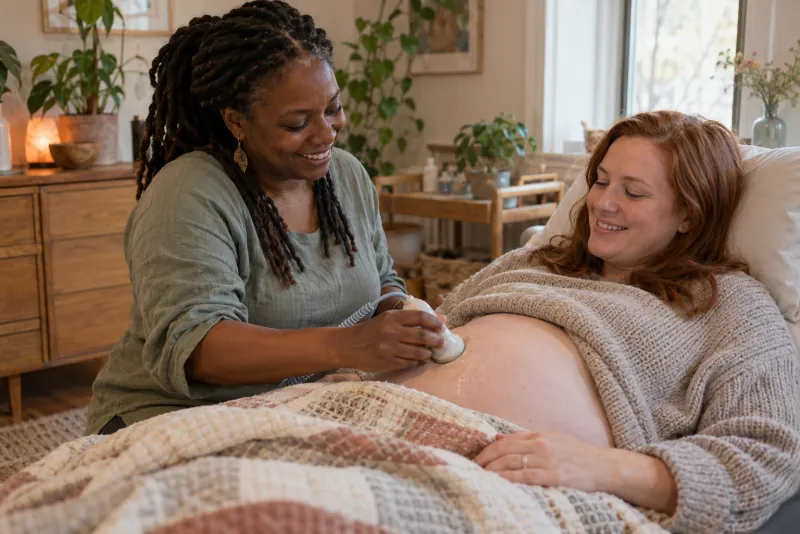
- Pickup. The specialist collects the placenta from the hospital or your home, usually in a cooler. One specialist loans a cooler if you don't have one [2].
- Preparation. The placenta is steamed, sliced and dehydrated, then ground into capsules [1][2]. Not every process includes steaming: the company in the CDC report described cleaning, slicing and dehydrating only [4].
- Delivery. You get the capsules with storage and dosage instructions, often within a few days [2].
Ask where the placenta will be prepared and how equipment is cleaned, since the CDC notes there are no standards for processing placenta for consumption [4].
Getting your placenta released from the hospital
Hospitals treat the placenta as tissue that can carry infection, so you'll need to plan ahead. One encapsulation trainer notes that some hospitals have no written policy, which leaves the decision to the staff on duty [7]. Ask your hospital for its policy before your due date, and put your request in your birth plan.
UNC Hospitals in North Carolina publishes its rules, and they show what to expect [3]:
- Paperwork. You sign a written authorization, witnessed by a provider, before the placenta is released.
- Packaging. Staff seal it in a labeled, leak-proof container and a biohazard bag. You bring a cooler or cooler bag, and the hospital can supply ice.
- Timing. You or someone you choose must take it off hospital property as soon as practical. It can be kept in a specimen refrigerator for up to 8 hours; after that, it's treated as abandoned and thrown out.
- When it won't be released. Not if there's documented or suspected chorioamnionitis or a bacterial infection, a bloodborne infection such as HIV, hepatitis B, hepatitis C or syphilis, or if the placenta was sent to pathology and preserved in formalin.
UNC also says it doesn't give instructions on preparing a placenta for consumption [3]. Other hospitals' rules may differ, so ask yours.
Line up a backup plan with your specialist: who picks up the placenta if you deliver at night, and what you're charged if the hospital doesn't release it.
What the CDC found
In 2016, Oregon health officials investigated a newborn who developed group B strep (GBS) in the blood a second time, five days after finishing treatment for the first infection [4]. The mother had started taking placenta capsules three days after the birth, two capsules three times a day [4]. Her capsules grew GBS, and the bacteria from the capsules and from the baby were genetically indistinguishable [4].
The company that made the capsules said it cleaned, sliced and dehydrated placentas at 115°F to 160°F before grinding them into capsules [4]. The CDC report concluded [4]:
- "The placenta encapsulation process does not per se eradicate infectious pathogens; thus, placenta capsule ingestion should be avoided."
- "No standards exist for processing placenta for consumption."
- Clinicians should ask about placenta ingestion in cases of late-onset GBS and tell mothers interested in encapsulation about the potential risks.
A small 2022 lab study in Germany found that steaming placenta tissue sharply cut GBS and E. coli counts, while raw tissue still supported bacterial growth [6]. The authors noted it used only 24 placentas in its clinical arm and non-sterile, home-style conditions [6]. One small study doesn't settle the question, so talk with your doctor and your baby's pediatrician before you decide.
What doctors' groups say
We couldn't find a formal guideline from the American College of Obstetricians and Gynecologists (ACOG) on eating the placenta.
A 2017 review in the American Journal of Obstetrics & Gynecology found "no scientific evidence of any clinical benefit of placentophagy among humans" [5]. Because the practice is potentially harmful with no documented benefit, the authors concluded that "physicians should discourage this practice" [5].
Questions to ask a placenta encapsulation specialist
- What's the total price, including pickup, travel and delivery?
- Do you steam the placenta first or use a raw method, and at what temperature do you dehydrate it?
- Where do you prepare it, and how do you clean your equipment between clients?
- What training or food safety certification do you have?
- What happens to my deposit if the hospital won't release the placenta, or if it's sent to pathology?
- How quickly will you pick it up, and what if I give birth at night?
Encapsulation is one of several costs families add around the birth. See what it costs to have a baby, cord blood banking costs, and if you want hands-on help at home after the birth, what a postpartum doula costs.
Questions people ask
How much does placenta encapsulation cost?
There's no national price survey. Published price lists we checked in October 2026 ranged from $225 to $397 for encapsulation with pickup, depending on the package and area. Some doulas charge their own clients less, such as $150.
Does insurance cover placenta encapsulation?
Plan on paying yourself. Encapsulation specialists bill families directly, often with a nonrefundable deposit before the birth and the balance when they deliver the capsules.
Will the hospital let me take my placenta home?
It depends on the hospital, so ask before your due date. UNC Hospitals, for example, releases it after you sign a witnessed authorization, but not if there's an infection, a bloodborne disease like HIV or hepatitis, or if it was sent to pathology and preserved with formalin.
Is placenta encapsulation safe?
The CDC reported a newborn's group B strep infection linked to the mother's placenta capsules in 2017, and said the encapsulation process doesn't eliminate infectious germs and that capsule ingestion should be avoided. Talk with your doctor and your baby's pediatrician before deciding.
What does ACOG say about placenta encapsulation?
We couldn't find a formal ACOG guideline on eating the placenta. A 2017 review in the American Journal of Obstetrics & Gynecology found no scientific evidence of a clinical benefit and said physicians should discourage it.
Sources
Numbers in brackets in the guide link to these sources.
- 1.Placenta products (pricing)April's Doula Services (Upstate South Carolina and Delmarva), 2026
- 2.Placenta encapsulation agreement (Ventura County, California)Jaymee F. Payan, placenta encapsulation specialist
- 3.Attachment 1: UNC Hospitals Labor and Delivery Instructions for Releasing the PlacentaUNC Hospitals (via SPICE, UNC), 2025
- 4.Notes from the Field: Late-Onset Infant Group B Streptococcus Infection Associated with Maternal Consumption of Capsules Containing Dehydrated Placenta, Oregon, 2016 (MMWR 2017;66:677-678)Centers for Disease Control and Prevention (CDC), 2017
- 5.Human placentophagy: a review (Farr A, Chervenak FA, McCullough LB, Baergen RN, Grünebaum A)American Journal of Obstetrics & Gynecology (record via Weill Cornell Medicine VIVO), 2017
- 6.Impact of tissue processing on microbiological colonization in the context of placentophagy (Johnson SK et al.)Scientific Reports (PubMed Central), 2022
- 7.Tips: Hospital release of placentasPlacenta Benefits (PBi)